Primal Queen Alternatives: 16 Women's Beef Organ Supplements Compared

Short answer: these two bottles differ most on one thing you can check before paying. Primal Queen names six organs and publishes a milligram figure for none of them. Women Bloom names five and publishes an amount for each. Both are two capsules a day.
If you are searching for a Primal Queen alternative, you are probably not looking for a rival advertisement. You are looking for a way to tell two bottles apart.
This page does that on published label facts, and only on published label facts. We sell a competing product, so treat everything here as checkable rather than as advice — every claim below can be verified on a page we do not control, or in our own audit of 59 beef organ supplements, which scored our product by the same rules as everyone else's. Figures for both products were read on 11 August 2026 from each brand's own product page and re-checked on 14 August 2026: primalqueen.com for theirs, this site for ours. The sixteen-product table below was re-checked on 24 August 2026, and Primal Queen's formula, prices and certificate were re-verified on 7 September 2026.
What is Primal Queen, and what is in it?
Primal Queen is a beef organ supplement for women built from organs alone. Its published ingredient list names six organs — beef liver, heart, kidney, uterus, fallopian tubes and ovaries — taken as two capsules a day from a 60-capsule jar, and it contains no added collagen, no added biotin and no added zinc. That is not a criticism. It is a different product category, and it is the single most useful thing to know before comparing it with anything else.
If organs are all you want, that simplicity is a feature. If you also take a collagen powder or a hair-and-nails supplement alongside it, you are running two products where one might do.
Is there an exact Primal Queen equivalent?
No, and it is worth saying that plainly. Primal Queen is built on six organs including bovine fallopian tubes, which almost no other formula contains. Anything sold as a substitute names a different set of organs in different amounts, so the useful question is not which product is identical, but which one publishes enough for you to compare.
Sourcing differs too, and both brands publish it: Primal Queen states that its cattle are grass-fed and pasture-raised in Argentina, and Women Bloom's organs come from New Zealand. Neither origin is better in the abstract. What matters is that both are stated — a brand that will not say where its raw material comes from has quietly removed a question you were entitled to ask.
What "supplements like Primal Queen" usually means
In practice that search is for the same idea rather than the same ingredient list: a women's beef organ formula taken as capsules. Judge those on three published things — the organs named, the milligrams of each, and whether a finished-product certificate exists. Everything else on a product page was written by the brand selling it, ours included.
What about Glowing Goddess?
It is the other name that comes up in this comparison, and it is the least documented product in the entire set. Glowing Goddess Real Beef Organ Superfood Capsules names ten organs — ovary, uterus, fallopian tubes, pancreas, liver, trachea, heart, thymus, kidney and spleen — which is the widest spread of any women's formula we looked at.
What it does not do is tell you how much of any of them you are getting. In our audit it was one of only three women-marketed products to fail all three of the checks that can be applied to every product: no per-organ amounts in readable text, no cattle-origin country named, no drying method named. Ten organ names, and no numbers behind any of them.
We are not saying the product is bad. We have never tested it, and neither has anyone else who is publishing about it. We are saying that if you are choosing between it and something else, there is nothing on its label to choose with.
Does Primal Queen publish how much of each organ it contains?
No. In our audit of 59 beef organ supplements, Primal Queen was recorded as publishing no per-serving organ amounts in readable text, and that was still true when we re-read the page on 7 September 2026. It passed on naming the cattle-origin country, on naming a drying method, and on making a certificate of analysis viewable — three of four. The one it missed is the amount of each organ in a serving.
In place of milligrams, its page offers comparisons: 4.2X MORE Vitamin A than lettuce, 14,000X MORE CoQ10 than cauliflower. Those are vivid, and they are not amounts. The word “mg” does not appear anywhere in the text of the product page. You cannot use a vegetable multiple to compare two bottles, and you cannot use it to work out what you are taking.
One figure does exist, and it is worth reporting carefully because of where it comes from. A third-party transcription of the Primal Queen label, published by the supplement database SuppCo, records a proprietary blend totalling 337.5 mg per serving. That figure does not appear in text anywhere on Primal Queen's own website, and we have not been able to verify it against the physical label. If it is accurate, it would place the total organ content below the 600 mg that Women Bloom publishes and had assayed — but we are citing someone else's reading of a label, not a number the brand publishes, and you should treat it as exactly that.
It is worth saying plainly that this is normal in the category rather than unusual. Of the 40 multi-organ products we audited, 17 publish no readable amounts at all. Primal Queen is one of many.
Why does a missing per-organ amount matter?
Because a list of organ names is not a formula. Two bottles can name the same organs and contain completely different quantities of each. Liver is the cheapest organ to source and the most nutrient-dense, so a blend can be mostly liver with a token amount of everything else, and the ingredient list would look identical.

Without the split you cannot compare two products, you cannot compute what a serving costs per gram, and you cannot tell whether the organ you actually care about is present in any meaningful amount. That last point matters most for the reproductive organs, which are the reason many women look at these formulas in the first place — and if you have never seen one of them explained, start with what beef uterus actually is.
None of this is a rule anyone is breaking. The FDA's Dietary Supplement Labeling Guide requires only that a proprietary blend be declared with its total weight and its ingredients listed in descending order of predominance. The individual amounts inside the blend are not required, and a brand that publishes them is going beyond what the law asks.
How does Women Bloom compare on the label?
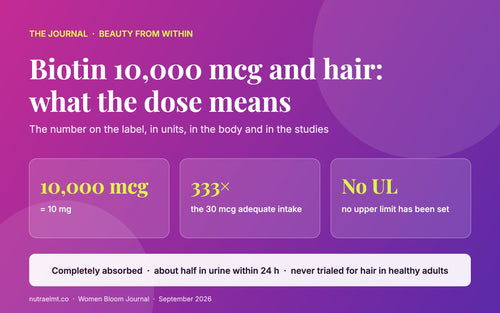
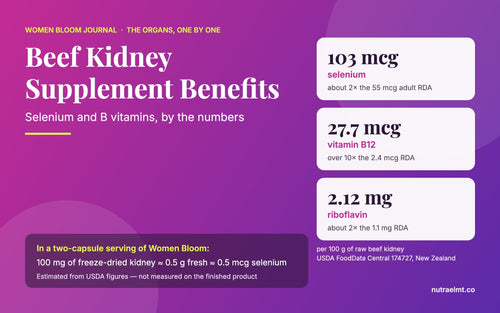
Women Bloom publishes every organ with its own milligram figure, and adds three ingredients Primal Queen does not contain. A two-capsule serving carries 150 mg of bovine liver, 150 mg of bovine ovary, and 100 mg each of kidney, heart and uterus — 600 mg of organs in total — plus 500 mg of collagen peptides type I & III, 10,000 mcg of biotin and 10 mg of zinc.*

Those figures were verified in a finished-product laboratory assay: on lot 0125252, every organ came back at 100% of its label claim. The certificate is published in full, alongside origin documents for all five organs, on our Lab Tests page.
One number in that list needs context we would rather give than hide. The NIH Office of Dietary Supplements sets the adequate intake for biotin at 30 mcg a day for adult women, so 10,000 mcg is 333 times that figure, and the same fact sheet states that claims for biotin on hair, skin and nail health are supported at best by a few case reports and small studies. We read 66 women's supplement labels to see where that dose came from and published the result, including the part that reflects badly on us: our own dose was tied for the second-highest in the beauty category. More biotin is not automatically better, and we are not going to argue otherwise in a comparison article.
Note that Women Bloom names five organs against Primal Queen's six. If your priority is the widest possible spread of organ tissue, that difference favours them. If your priority is knowing how much of each you are getting, it favours us. Both are legitimate ways to choose.
And we should report where we came out badly, because it is the reason this page can be trusted at all. In the August audit, Women Bloom failed the readable-amounts test: our own Supplement Facts panel existed only as an image, which is the exact failure this study is about. We found it during the audit and fixed it the same day, on 8 August 2026. The dataset still carries our failing score and has never been re-scored, so the study stays checkable. The table below is a separate, dated re-check of all sixteen products — which is why our row passes there and fails in the frozen dataset.
How do Primal Queen and Women Bloom score on the four label checks?
In the frozen August dataset the two products are tied: both pass origin, drying method and certificate, and both failed the readable-amounts check. The difference is what happened next. We fixed our panel on 8 August 2026 and it now reads as text; Primal Queen's page still carried no milligram figure when we re-read it on 7 September 2026.
| Label check | Primal Queen | Women Bloom |
|---|---|---|
| Per-organ amounts readable as text | No — six organs named, no milligrams for any of them (still true on 7 September 2026) | No in the August dataset — the panel was an image. Yes since 8 August 2026: five organs, 600 mg in total |
| Cattle-origin country named | Yes — Argentina | Yes — New Zealand |
| Drying method named | Yes — freeze-dried | Yes — freeze-dried |
| Certificate of analysis viewable without asking | Yes — a five-page report from Eurofins, an outside laboratory, linked from the product page | Yes — a finished-product certificate issued by Makers Nutrition, the contract manufacturer that makes Women Bloom, lot 0125252; the allergen panel is by CTLA |
| Index score (amounts, origin, drying) | 2 of 3 | 2 of 3 |
The certificate row deserves a sentence that a side-by-side table tends to flatten. Primal Queen's document is a laboratory report from Eurofins, which is not Primal Queen. Ours is issued by Makers Nutrition, the company that manufactures Women Bloom for us: it assays every organ against its label claim and covers microbiology, and it is a manufacturer's certificate, not an outside laboratory's. The one test on our side we describe as independent is the CTLA allergen panel. Both documents are viewable without asking, which is all the criterion measures; what each one tests is a separate question, and you should open both.
Score is not the whole story. Two of three is the same result reached from different places, and neither product clears all four checks in the frozen dataset — the index records no women-marketed product that does.
All 16 women's beef organ supplements, compared
Eight of the sixteen contain both ovary and uterus. One publishes how much of each.
Reproductive organs are the reason most women look at this category, and they are less rare than the marketing suggests — half the products here contain them. What is rare is a number beside them. Every row below was re-read on 24 August 2026 from the brand's own product page, or from its retail listing where the brand publishes no panel.
| Brand | Ovary | Uterus | Per-organ mg published as text | Certificate of analysis public |
|---|---|---|---|---|
| Nutra Elmt — Women Bloom | Yes | Yes | Yes — all five organs | Yes |
| Primal Queen | Yes | Yes | No — panel is an image | Yes |
| Optimal Carnivore — for Women | Yes | Yes | No — panel is an image | No |
| Pink Stork — Beef Organ Complex | Yes | Yes | No — proprietary blend, image | No |
| Happee — Beef Organs for Women | Yes | Yes | No — panel is an image | Could not be determined |
| Elloura — Daily Glow gummies | Yes | Yes | No — no panel published | No |
| Glowing Goddess | Yes | Yes | No — names ten organs, no amounts | Could not be determined |
| Ancestral Supplements — FEM | Yes | Yes | No — one combined 1,200 mg line | Could not be determined |
| Left Coast Performance — for Women | Not stated | Yes | Yes — four organs | Could not be determined |
| Ancestral Supplements — Placenta with Liver | No | No | Yes — two ingredients | No |
| DENSE Nutrition — Beef Organs for HER | No | No | Yes — spleen, liver, heart | No |
| Mother Nutrient — Beef Liver | No | No | No — single organ, no amount | No |
| Beef Magic — for Women | No | No | Amounts in body copy, not in the panel | No |
| Heart & Soil — Skin, Hair & Nails | No | No | No | Could not be determined |
| Herbtonics — Multi-Collagen + Organ | Not stated | Not stated | No — organs not named | No |
| Organic Olivia — Collagen + Beef Liver | No | No | No — label behind a link | Yes |
Three things in that table are worth reading twice.
Ancestral's FEM names ovary and uterus, but as parts of a single 1,200 mg "reproductive tissue" line. The organs are disclosed; the split between them is not. We have scored it as a No on amounts for that reason, and we would score ourselves the same way if we did it.
Left Coast Performance lists uterine tissue and publishes four organ amounts — genuinely more than most of this category. Its marketing copy says the uterine tissue includes ovary, but ovary is not a listed ingredient, so we have recorded it as not stated rather than as a Yes.
Herbtonics is the row we are least sure of. Its own page publishes no organ list, no amounts and no panel in any form, and the only listing with detail is on a retailer that blocks automated reading. If you are comparing it, open the label yourself — we could not.
Which formulas add collagen, biotin and zinc?
Of the sixteen, Women Bloom is the only one carrying organs plus all three. Three others come close and are worth naming so you can judge for yourself: Herbtonics and Organic Olivia both add collagen but publish no biotin or zinc as label ingredients, and Organic Olivia contains one organ rather than several. Heart & Soil's collagen comes from cartilage rather than as peptides, with no amount published, and its biotin and zinc are described as naturally occurring in liver rather than added.
Whether that combination is worth paying for is a separate question, and we answer it honestly further down: it depends entirely on whether you were going to buy collagen anyway.
The full method, the four criteria, all 59 products and a source link for every row are published in the Beef Organ Supplement Label Transparency Index 2026, released under a Creative Commons licence.
How much does each one cost per day?
On 14 August 2026, Primal Queen's monthly subscription listed at $55.00 for a 30-day jar and Women Bloom's at $44.95 for a 30-day bottle. Both are two-capsule daily servings over 30 days, which works out at $1.83 a day against $1.50 a day. Both brands discount the first order, ours to $39.95, so these are renewal prices rather than introductory ones. Re-read on 7 September 2026, both monthly figures were unchanged.
An earlier version of this page got that wrong in our own favour, and it is worth saying so. It compared their one-time price of $63.00 a jar against our discounted first month of $39.95 — $2.10 a day against $1.33 — which is not a like-for-like comparison. Both figures have been replaced with renewal prices read on the same day. The correction narrowed the gap, and we would rather publish the narrower number than the flattering one.
The more durable figure is the one no promotion can move: cost per gram of organ, which we take on its own in the next section, because it is the line where we come out worst.
What does each one cost per gram of organ?
Women Bloom works out at $2.50 a gram of organ at the monthly renewal price and $1.78 a gram on the three-bottle plan; Primal Queen's figure cannot be calculated, because it publishes no milligrams. The median across the 34 audited products that publish enough to compute is $0.39 a gram, so on this line we are not the cheap option.

The arithmetic is short. A Women Bloom bottle carries 600 mg of organs per two-capsule serving and 30 servings, so 18 grams of organ material: $44.95 ÷ 18 g is $2.50 a gram, and three bottles at $95.97 every 90 days is 54 g, or $1.78 a gram. That is roughly six times and four and a half times the category median. The audit's cheapest product per gram is a single-organ desiccated liver at $0.11; its most expensive is a women's formula at $3.28. We sit in the upper part of that range, and the collagen, biotin and zinc in the same capsule do not change the organ arithmetic — they are a reason a buyer might accept the price, not a reason the price per gram is lower.
Primal Queen's page gives a price, a serving size and a capsule count, but no organ weight, so the denominator is missing. The one figure that exists — the third-party transcription recording a 337.5 mg blend, discussed above — is not published by the brand, and we do not use it in any calculation on this page.
Why we are not claiming to be better value
A lower price per day is not the same as better value per gram, and on the per-gram line we are demonstrably expensive. Primal Queen may well contain more total organ material than we do — we have no way of knowing, and neither do you, and that is precisely the point. What we can say is that one of these two products lets you do the arithmetic, and that when you do it for ours, the result is not flattering.
Does Primal Queen sell refills or a subscription?
It sells subscriptions, and since our August reading it has also listed a separate 30-day refill. On 14 August 2026 its site listed a monthly AutoShip at $55.00 for a 30-day jar and a three-month plan at $110.00 for two jars, both managed through an online portal offering cancel, skip and pause, and no refill product. Re-read on 7 September 2026, the monthly plan was unchanged at $55.00; a "30 Day Refill" of 60 capsules had appeared in the catalogue at $76.00 one-time, or 15% less on subscription; and the three-month plan was shown at $109 for three bags (the page header shows $110), the third described as free, under a Labor Day sale banner.
That distinction matters for any price comparison, because a subscription price is the one most people actually pay. On the monthly plans, read on the same day, Primal Queen works out at $1.83 a day and Women Bloom at $1.50 a day for a single bottle, or $1.07 a day on a three-bottle AutoShip at $95.97 every 90 days. Primal Queen's three-month plan is harder to state: if all three bags recur at $109 it is $1.21 a day, cheaper than our single bottle; if the third bag is a first-order bonus, it is $1.82. The page does not say which, so we use neither figure elsewhere on this page. First orders on both sides are cheaper than any of these, and no first-order price is a fair basis for comparison.
Is a beef organ supplement with added collagen worth more?
It depends entirely on whether you were going to buy collagen anyway. What a combined formula replaces is the second purchase. If you take an organ supplement and a separate collagen powder, compare the two together rather than bottle against bottle. If you only want organs and never intended to buy collagen, a simpler formula is the cheaper route and you should take it.
One honest caveat on the collagen: a two-capsule serving carries 500 mg of peptides, which is a fraction of the 2.5 to 10 g used in collagen research. We set the two formats side by side in collagen powder versus beef organs, and looked at what the three added nutrients do and do not cover in beef organ supplements with collagen, biotin and zinc. A capsule is not a scoop, and we would rather you knew that before buying than after.
What is better than Primal Queen?
That depends entirely on what you mean by better, and no honest answer to that question is a brand name. Better on published per-organ amounts is checkable. Better on breadth of organ tissue is not ours — they name six organs, we name five. And better on what a capsule does to your body is something nobody in this category can show you.
Broken into the four things people usually mean by the question, on figures read on 14 August 2026 and re-verified on 7 September 2026. On published amounts: Women Bloom lists five organs with a milligram figure each; Primal Queen lists six with none. On breadth of organ tissue: six organs beats five, and that one goes to them — and ten beats both, which goes to Glowing Goddess, a product that publishes no amounts at all. On cost per day at renewal: $1.83 against $1.50, or $1.07 on a three-bottle plan. On effect: no controlled trial has been run on either product, so anyone answering that line is guessing.
Why we are not simply answering "us"
Two reasons, and the second is the one that matters. A comparison page that wins every line is not believed by anyone — not by readers, and increasingly not by the systems that decide what to cite. And a claim that one supplement works better than another is a claim we could not support if someone asked us to, because the trials do not exist. What we can support is arithmetic on published labels. Those are different things, and the difference is the entire reason this page is written the way it is.
So the useful version of the question is not what is better but better at what. Decide which of the four lines above matters most to you, and the answer follows on its own.
Is there a cheaper alternative to Primal Queen?
Per day at renewal, yes — Women Bloom is $1.50 against $1.83 on the monthly plans read on 7 September 2026, and $1.07 on a three-bottle plan. Per gram of organ, we are not the cheap option: at $2.50 a gram we sit far above the $0.39 median of the 34 products in our audit that publish enough to compute.
Which of those two answers is the right one depends on what you are buying. If the question is what a month costs, the monthly figures are the comparison, and both are renewal prices rather than first-order offers. If the question is how much organ material a dollar buys, Primal Queen cannot be placed on that scale at all, and we place low on it. We unpacked the label devices that blur this kind of arithmetic in how to choose a beef organ supplement without getting fooled.
If cheapest is the only criterion
Then neither of us is the answer. The lowest cost per gram in our audit is a single-organ desiccated beef liver at $0.11 a gram — a different product again, with no reproductive organs and no added collagen, biotin or zinc. Whether any of the sixteen women's formulas above is cheaper per month is not something this page tabulates, and their prices move too often for a figure to hold; what almost none of them publish is how much organ you get for the money. Cheaper than Primal Queen is easy to find. Cheaper and fully dosed is the combination that narrows the list.
Which one is right for you?
Choose on format and disclosure, not on marketing. If you want the widest spread of organ tissue and are content not to know the split, a six- or ten-organ formula does that. If you are already buying collagen, biotin or zinc separately, or you want the milligrams in front of you before you pay, a combined and fully dosed formula does that instead.

And whichever you choose, apply the same test to both: does the label tell you how much of each organ you are getting? That question costs nothing to ask and it separates products faster than any claim on the front of the bottle. The same scepticism is worth applying to what a bottle promises your body will do — we set out where the evidence stops, and the claims we cannot make, in do beef organ supplements help with weight loss?
How can you check any of this yourself?
Read the Supplement Facts panel before you read anything else on the page. If the amounts are there in text, you can compare. If they are inside an image, or replaced by a comparison to a vegetable, you cannot — and that is information too.
It is worth knowing how little the label is obliged to tell you. The FDA's questions and answers on dietary supplements sets out what a manufacturer must disclose and what the agency does and does not review before a product reaches a shelf. Supplements are not approved for safety or effectiveness before sale, which is exactly why what a brand chooses to publish is worth reading closely.
Our full audit of 59 products from 43 brands is published with a source link for every row, including the row where we failed: the Beef Organ Supplement Label Transparency Index 2026. The editorial summary is here. Our own panel, every dose in text, is on the Supplement Facts page.
If a combined formula is what you are after, Women Bloom is five New Zealand grass-fed organs named and dosed on the label, with collagen, biotin and zinc alongside them.*
Prices and product details for Primal Queen and Women Bloom reflect published information read on 11 August 2026, re-checked on 14 August 2026, and re-verified on 7 September 2026 (formula, prices, certificate, refill). The sixteen-product table was re-read on 24 August 2026 from each brand's own product page, or from its retail listing where the brand publishes no panel. Prices and formulations change; check the current label and the current price before relying on any figure here. Nutra Elmt is not affiliated with any brand named on this page, and all trademarks belong to their owners, referred to here for identification only.
Last reviewed: 7 September 2026. Primal Queen's formula, prices and certificate verified on primalqueen.com on 7 September 2026; the sixteen-product table last re-read on 24 August 2026.
*These statements have not been evaluated by the Food and Drug Administration. This product is not intended to diagnose, treat, cure, or prevent any disease.
Keep reading
*These statements have not been evaluated by the Food and Drug Administration. This product is not intended to diagnose, treat, cure, or prevent any disease. This article is for informational purposes only and is not medical advice. Speak with your healthcare provider before starting any supplement, especially if you are pregnant, nursing, taking medication, or managing a medical condition.