Beef Uterus in a Supplement: What It Actually Is

If you have looked at the label of a women's organ supplement and stopped at beef uterus, you are not alone. It is the ingredient people ask about most, and the one almost nobody explains properly. This article gives you a plain answer, including where the evidence is thin. If you want the wider picture first — what these formulas contain and how to compare two labels — start with our complete guide to beef organ supplements for women.
What is beef uterus in a supplement?
Beef uterus is uterine tissue from cattle, dried and ground into a powder that is then encapsulated. In quality formulas it is freeze-dried rather than heat-dried, and sourced from pasture-raised animals. It is a whole-food ingredient in the same sense that beef liver is: an edible organ, eaten in many food cultures, concentrated into a capsule.
It belongs to a category called glandulars — supplements made from animal organs and glands. The practice is old. Traditional food systems around the world treated organ meats as the most valuable part of the animal, and modern organ supplements are a convenience version of that idea.
Why do women's organ formulas include it?
The reasoning behind glandulars is a traditional principle sometimes summarised as like supports like — the idea that consuming an organ provides tissue-specific nutrients and peptides relevant to that organ in the person eating it.
Here is the honest position: that principle is traditional, not proven. There is no large body of controlled human trials showing that eating bovine uterine tissue produces a measurable effect on the human uterus. Any brand telling you otherwise is ahead of the evidence.
What is not in dispute is that organ tissue is nutrient-dense — it carries protein, minerals and B vitamins in a whole-food matrix rather than as isolated synthetic compounds. That is the defensible reason to include it, and it is the one we stand behind.*
What nutrients does beef uterus provide?
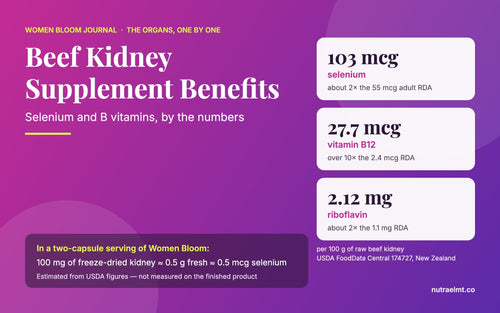
Uterine tissue is muscular tissue, so its profile leans toward what muscle provides: complete protein, iron, zinc, selenium and B vitamins, including B12. It is far less concentrated than liver, which is the standout organ for vitamin A and B12 — you can see the full breakdown of what is in each capsule on our Supplement Facts panel, where uterus is listed at 100 mg within a 600 mg total organ blend per two-capsule serving.
If you want to compare organ nutrient profiles against primary data rather than marketing copy, the USDA FoodData Central database lists composition for beef organ meats, and the NIH Office of Dietary Supplements publishes fact sheets for each individual nutrient.
Is beef uterus the same as bovine ovary?
No. They are two different organs and they appear separately on a label. Uterus is muscular tissue; ovary is glandular tissue. A formula that lists only one of the two is not the same as a formula that lists both, and some products list a vague "female glandular blend" without saying which organs it contains or in what proportion.

That vagueness is worth noticing. A label that names each organ tells you more than one that does not — and for the other half of the picture, we explain what a beef ovary supplement is and why it appears in women's formulas in its own article.
How much beef uterus is in a typical formula?
In a five-organ women's blend, uterus is usually one component of a total organ dose measured in hundreds of milligrams — not the dominant ingredient. Liver typically leads, because it carries the highest nutrient density.
Many brands hide the split inside a proprietary blend, which lets them list a large-sounding total without disclosing how little of each organ is present. If a label does not break the blend down, you cannot know what you are taking. That is not a hypothetical: the most searched women's organ formula on the market names six organs and publishes a milligram figure for none of them, which we set out line by line in our label comparison with Primal Queen.
Ours does break it down, which is the only way you can check the answer for yourself: Women Bloom lists all five organs by name and by amount — 150 mg ovary, 150 mg liver, and 100 mg each of kidney, heart and uterus, for 600 mg of organs in a two-capsule serving.
Where do the organs come from?
Ours come from New Zealand grass-fed cattle, from herds that graze year-round rather than finishing on grain. Every organ in the formula carries origin documentation from its supplier, published on our Lab Tests page along with our third-party allergen screen and our NSF GMP facility certification.
Sourcing matters more than most people realise. Organs concentrate what the animal was exposed to, which is why country of origin and farming system are not marketing details — they are the product, and one of the few label checks on which Primal Queen and Women Bloom tie.
Is beef uterus safe, and who should avoid it?
For most healthy adults, organ supplements from inspected, pasture-raised cattle are a food ingredient and are generally well tolerated. That said:
- If you are pregnant or nursing, speak with your healthcare provider before taking any organ supplement. Liver in particular is very high in preformed vitamin A, and intake during pregnancy needs medical guidance — we set out the numbers in can you take beef organ supplements while pregnant?
- If you have a beef allergy, avoid it entirely.
- If you take medication or manage a medical condition, check with your physician first.
How is it processed, and does that matter?
Yes, and it is one of the few processing questions with a clear answer. Freeze-drying removes water at low temperature, which preserves heat-sensitive nutrients. Heat-drying is cheaper and faster, and degrades some of them.

If a label does not state the drying method, it is reasonable to assume the cheaper one. Freeze-dried is a claim brands make when it is true, because it costs more.
The short version
Beef uterus is bovine uterine tissue, freeze-dried and encapsulated, included in women's organ formulas as part of a whole-food nutrient matrix. The traditional rationale behind glandulars is not backed by strong clinical evidence, and anyone claiming otherwise is overselling. What you can reasonably evaluate is sourcing, processing method, and whether the label tells you how much of each organ you are actually getting.*
That last point is the one worth shopping on, because it is the only one you can verify before you buy. Women Bloom names and doses all five organs on the label, freeze-dried from New Zealand grass-fed cattle, with collagen peptides, biotin and zinc alongside them.*
Last reviewed: August 2026.
*These statements have not been evaluated by the Food and Drug Administration. This product is not intended to diagnose, treat, cure, or prevent any disease.
Keep reading
*These statements have not been evaluated by the Food and Drug Administration. This product is not intended to diagnose, treat, cure, or prevent any disease. This article is for informational purposes only and is not medical advice. Speak with your healthcare provider before starting any supplement, especially if you are pregnant, nursing, taking medication, or managing a medical condition.