Beef Ovary Supplement: What It Is and Why It's in Women's Formulas

Beef ovary is the ingredient women ask about most and the one brands explain least. It appears on a label between the liver and the collagen, usually with no note about what it is or why it is there. This page answers that plainly — including the parts where the evidence runs out.
If you arrived here from the label itself, its neighbour is worth reading too: what beef uterus actually is covers the other organ almost nobody explains.
What is a beef ovary supplement?
A beef ovary supplement is ovarian tissue from cattle, dried and ground into a powder that is then encapsulated. In better formulas it is freeze-dried rather than heat-dried, and taken from pasture-raised animals. It is a whole-food ingredient in the same sense beef liver is: an edible organ, concentrated into a capsule.
It belongs to the category known as glandulars — supplements made from animal organs and glands. Ovary is glandular tissue, which is what distinguishes it from uterus, a muscular tissue that appears separately on the same panel. Two organs, two lines on a label, two different things.
Why do women's formulas include beef ovary?
The reasoning is a traditional principle sometimes summarised as like supports like: the idea that eating an organ supplies tissue-specific nutrients and peptides relevant to the same organ in the person eating it. It is the oldest argument in the category — and it is the weakest one.
Here is the honest position: that principle is traditional, not demonstrated. There is no substantial body of controlled human trials showing that consuming bovine ovarian tissue produces a measurable effect on the human ovary. A brand that implies otherwise is ahead of its evidence, and you should read the rest of its claims with that in mind.
What is not in dispute is narrower and more defensible: organ tissue is nutrient-dense, and it delivers protein, minerals and B vitamins in a whole-food matrix rather than as isolated synthetic compounds. That is why we include it, and it is as far as we are willing to go.*
Does beef ovary contain hormones?
A beef ovary supplement is not a hormone product and is not sold as one. It is dried tissue from an animal, and no reputable organ supplement standardises, measures or advertises a hormone content. Hormone therapy is a category of medicine, prescribed and monitored by a physician. Organ capsules are food.
Why the question keeps coming up
Because the ovary is a hormone-producing organ in the living animal, people reasonably assume the dried tissue carries that function forward. Marketing in this category has not been careful about correcting the assumption, and some brands lean on it without saying anything specific enough to be held to.
If you are considering a supplement because of a hormonal concern, that is a conversation for your healthcare provider, not a label. The FDA is explicit that dietary supplements are not intended to diagnose, treat, cure or prevent any disease, and we would rather say that in the body of an article than only in small type at the bottom.
What nutrients does beef ovary provide?
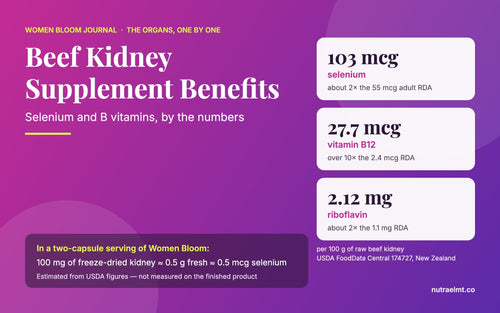
Ovarian tissue is glandular tissue, so its profile leans toward complete protein, minerals such as zinc and selenium, and B vitamins including B12. It is not the nutrient leader in a five-organ blend — liver is, by a wide margin, and that is true in every formula regardless of which one you buy.

Two caveats belong here rather than in a footnote. First, published composition data for bovine ovary is thin compared with liver, heart and kidney — the USDA FoodData Central database covers the common organ meats far better than the reproductive ones. Second, whole-food nutrient content varies with the animal, the pasture and the batch, which is exactly why a per-organ amount matters more than an organ name. Ours is on the Supplement Facts page: 150 mg of bovine ovary powder within a 600 mg total organ blend, per two-capsule serving.
For what each of those nutrients does in the body, the NIH Office of Dietary Supplements publishes a fact sheet per nutrient, and PubMed indexes the primary literature on organ meat composition. Both are better starting points than any brand's own summary, including this one.
How can you tell a label really contains beef ovary?
Look for the word "ovary" spelled out, with a milligram figure beside it. A great many women's formulas list a "female glandular blend" or a "reproductive complex" without naming the organs inside, which means the ovary may be present in a token amount, or not at all.

The proprietary blend problem
A proprietary blend lets a manufacturer print one impressive total — say 3,000 mg of organs — without disclosing the split. Liver is the cheapest and most abundant organ to source, so it is reasonable to assume it dominates unless the label says otherwise. If the breakdown is missing, you are not choosing between formulas; you are choosing between marketing copy.
Our own five organs are listed by name with their amounts — 150 mg ovary, 150 mg liver, and 100 mg each of kidney, heart and uterus. If you want the label itself, it is on the Women Bloom product page.
For a like-for-like example of what that changes once you compare two real products rather than two claims, we set the published figures side by side in how Primal Queen compares on disclosed milligrams and cost per day. We also scored the labels of 59 brands on the same four disclosures in our audit of 59 beef organ supplements.
Where does beef ovary come from?
Ours comes from New Zealand grass-fed cattle, as does every other organ in the formula, from herds that graze year-round rather than finishing on grain. Each organ carries origin documentation from its supplier, and those documents are published on our Lab Tests page alongside our third-party allergen screen and our NSF GMP facility certification.
One detail worth knowing, because it explains a lot about this category: bovine ovary is materially harder to source than liver or heart. A single animal yields very little of it, and few processors collect it at food grade. That is why our five organs come from three different New Zealand suppliers rather than one, and it is also why a great many women's formulas quietly leave the ovary out or bury it in an unnamed blend — which is why an origin country and a per-organ figure are two of the four label checks we score Primal Queen and ourselves on. Scarcity is the reason, not preference.
Is beef ovary safe, and who should avoid it?
For most healthy adults, organ supplements made from inspected, pasture-raised cattle are a food ingredient and are generally well tolerated. Reactions, when they occur, are usually digestive and usually related to taking capsules on an empty stomach — the same timing that produces the savoury repeat we look at in whether beef organ supplements taste or smell. There are, however, clear exceptions.
- Pregnant or nursing. Speak with your healthcare provider before taking any organ supplement. Liver is very high in preformed vitamin A, and intake during pregnancy needs medical guidance.
- Beef allergy. Avoid entirely.
- Taking medication or managing a medical condition. Check with your physician first, particularly if iron status is being monitored.
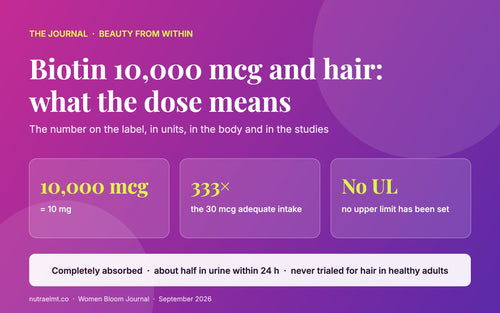
- Booked in for blood work. Women's organ formulas usually also contain high-dose biotin, which can distort several common laboratory tests. We explain how biotin affects blood test results, at what dose, and what to tell your lab.
Sourcing deserves more attention than it usually gets. Organs concentrate what the animal was exposed to, which makes country of origin and farming system part of the product rather than a marketing detail.
How long before you would notice anything?
Longer than most labels imply. Nutrient-related changes follow biological timelines, not purchase dates: hair grows roughly half an inch a month, and nails replace themselves over about four to six months, so anything visible in those tissues is a matter of months rather than weeks.*
Anyone promising a two-week transformation is selling the expectation rather than the product. The reasonable framing is that a whole-food organ supplement contributes nutrients your diet may be short on, and that consistency over a few months is what makes the question worth asking at all.*
The short version
Beef ovary is bovine ovarian tissue, freeze-dried and encapsulated, included in women's organ formulas as glandular tissue within a whole-food nutrient matrix. It is not a hormone product. The traditional rationale behind glandulars is not supported by controlled human trials, and we would rather say so than imply otherwise. What you can actually evaluate is sourcing, drying method, and whether the label names each organ and its amount — and those three questions will tell you more about a brand than any claim it makes.*
Last reviewed: August 2026.
Keep reading
*These statements have not been evaluated by the Food and Drug Administration. This product is not intended to diagnose, treat, cure, or prevent any disease. This article is for informational purposes only and is not medical advice. Speak with your healthcare provider before starting any supplement, especially if you are pregnant, nursing, taking medication, or managing a medical condition.