Does Biotin Affect Blood Test Results?

Most hair, skin and nail supplements contain high-dose biotin. Almost none of them tell you that it can distort a blood test. We sell one, and we would rather you heard it from us than from a confused lab result.
Does biotin affect blood test results?
Yes. Biotin taken above recommended intakes can produce falsely high or falsely low results on laboratory tests that use biotin–streptavidin technology, according to the NIH Office of Dietary Supplements. The vitamin does not change your body chemistry; it interferes with how the machine measures it.
That distinction matters. Nothing is happening to your thyroid or your heart. The assay is being misread, which is a different problem — and a solvable one, provided somebody knows to look for it.
Which blood tests does biotin interfere with?
The tests most often reported are thyroid function tests, troponin, NT-proBNP and 25-hydroxyvitamin D. Direction varies: biotin can push a result up or down depending on whether the assay is a competitive or a sandwich format. The same supplement can therefore cause opposite errors on two different tests.

The thyroid picture
Published case reports describe patients whose results falsely indicated Graves' disease and severe hyperthyroidism while taking high-dose biotin. Typically TSH reads low and free T4 and T3 read high — the classic signature of an overactive thyroid, produced by a vitamin rather than a gland.
The one that is not reversible
Troponin is the test used to help identify a heart attack. Biotin interference pushes it down, meaning a result can come back reassuring when it should not. The FDA has reported a patient death following a falsely low troponin result attributed to biotin interference. This is the reason the topic deserves an article rather than a footnote.
How much biotin does it take to interfere?
Less than you might assume. A single 10 mg oral dose has been shown to interfere with thyroid function tests performed within 24 hours, and a small study in six healthy adults taking 10 mg daily for one week found falsely decreased TSH and NT-proBNP. Case reports of falsely indicated hyperthyroidism involve intakes from 10 mg per day upward.
Here is the number that concerns our own customers directly: 10,000 mcg is 10 mg. That is the amount of biotin in a two-capsule serving of our formula, and it is the same order of magnitude as the doses in the published reports. We are not going to describe that as a rounding error. If you take this product, or any other high-dose biotin product, you should assume it is relevant before a blood draw.
For scale, the Adequate Intake for adults is 30 mcg per day, and typical dietary intake in Western populations runs about 35 to 70 mcg per day. High-dose beauty supplements sit several hundred times above that.
How long before a blood test should you stop taking biotin?
There is no single published interval that applies to everyone, and any brand quoting you one precise number is guessing. The appropriate pause depends on the dose you take and on the specific analyser your laboratory uses. What the literature does establish is that a 10 mg dose can still interfere 24 hours later.
The practical answer is to ask the laboratory or the ordering physician, and to tell them the dose. They know which platform they run and whether it has been reformulated to resist biotin interference — some have, some have not, and the FDA maintains a list of troponin assays that have not.
What should you tell your doctor or the lab?
Say that you take biotin, and say how much, in milligrams. Laboratory staff think in milligrams; supplement labels are printed in micrograms. "I take 10,000 micrograms" and "I take 10 milligrams" are the same sentence, but only one of them lands.

One boundary worth stating plainly: this concerns a dietary supplement. Do not stop prescribed medication because of anything you read here, including on this page. That decision belongs to your physician.
Is high-dose biotin harmful?
The two questions get confused, so they are worth separating. The Food and Nutrition Board has not established a Tolerable Upper Intake Level for biotin, because there is no evidence in humans that it is toxic at high intakes. Studies have found no adverse effects at 10 to 50 mg per day.
So the concern with high-dose biotin is not poisoning. It is diagnostic: the risk is that a test tells your doctor something untrue. That is a real risk, and it is managed by disclosure rather than by avoidance.
Why does a beauty supplement contain 10,000 mcg?
Honestly? Because the category standardised on that number, not because 10,000 mcg has been shown to be the effective dose. We should say what the evidence actually supports.
The NIH's assessment is that claims for biotin supplementation on hair, nail and skin health are supported "at best, by only a few case reports and small studies". The brittle-nail research involves small groups, no placebo control, and doses around 2.5 mg. The hair evidence is limited to case reports in children with a rare hair-shaft disorder. Biotin deficiency does cause hair thinning and brittle nails — but deficiency is rare, and correcting a deficiency you do not have is not the same as an improvement.*
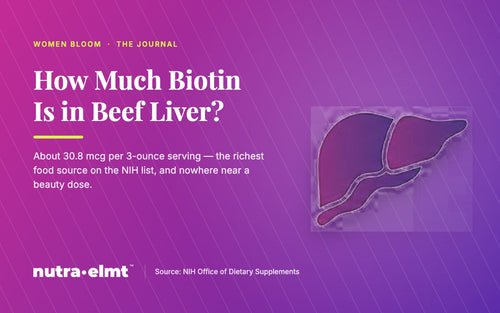
For scale against food rather than against other supplements, we break down how much biotin is in beef liver — about 30.8 mcg per 3-ounce serving, the richest food source on the NIH list, and still a different order of magnitude from a capsule.
That is a strange thing for us to publish about our own ingredient. We think it is the correct thing to publish. You can see the full dose on our Supplement Facts page, alongside every other amount, and decide for yourself whether it suits you. If you want the context on the organ side of the formula, we cover what beef ovary is and why it appears in women's formulas with the same approach.
The short version
High-dose biotin can distort thyroid tests, troponin, NT-proBNP and vitamin D assays by interfering with the measurement rather than with your body. A single 10 mg dose has interfered within 24 hours, and 10,000 mcg is 10 mg. It is not toxic — no upper intake level has been established — but it is a diagnostic hazard that costs nothing to defuse: tell the lab the dose in milligrams, ask them how long to pause, and never stop a prescription over an article.
Last reviewed: August 2026. This page is general information about a documented assay interference. It is not medical advice.
Keep reading

*These statements have not been evaluated by the Food and Drug Administration. This product is not intended to diagnose, treat, cure, or prevent any disease. This article is for informational purposes only and is not medical advice. Speak with your healthcare provider before starting any supplement, especially if you are pregnant, nursing, taking medication, or managing a medical condition.