Biotin 10,000 mcg and Hair: What the Dose Means

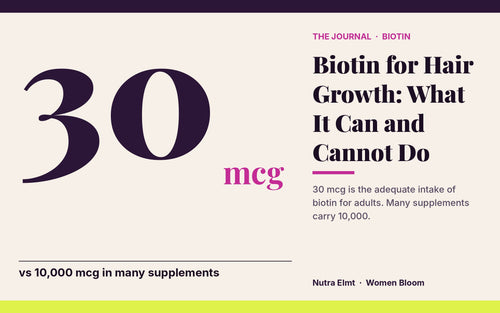
Biotin 10,000 mcg is 10 milligrams — 333 times the 30 mcg adequate intake and 33,333 percent of the Daily Value. It is completely absorbed, cleared in urine within days, has no established upper limit, and has never been tested for hair in healthy adults.
This page is one of the satellites of our guide to hair, skin and nails supplements for women. Our own label carries the number, so this article does the arithmetic on it: what the dose means in units, where it goes in the body, what the hair studies actually used, and the one practical thing it changes.
What does biotin 10,000 mcg actually mean?
It means 10 milligrams per serving: 1,000 micrograms make a milligram, so 10,000 mcg and 10 mg are the same dose written two ways. Against the 30 mcg a day the NIH sets as the adult adequate intake, that is 333 times the reference figure — which is why a label prints it as 33,333 percent of the Daily Value.

The micrograms are the confusing part. Labels use the unit that keeps the number readable, so a beauty label reads 10,000 where a pharmacology paper writes 10 mg. The 2017 JAMA study that tested this exact amount in healthy adults describes 10 mg a day as a dose common in over-the-counter supplements. For scale in food terms, the richest source on the NIH list, cooked beef liver, carries 30.8 mcg per 3-ounce serving — see how much biotin is in beef liver. A 10,000 mcg capsule is about 325 of those servings.
Will 10,000 mcg of biotin grow your hair?
No trial has shown that it does in a healthy adult. A 2017 systematic review found 18 cases of biotin used for hair or nail changes, all with an underlying cause — mostly children with an inherited enzyme deficiency — and no randomized trial in healthy people. Where 10,000 mcg appears there, it is a treatment dose for those children.
The review, Patel and colleagues in Skin Appendage Disorders, lists the doses: 10,000 to 30,000 mcg a day for inherited biotinidase or holocarboxylase deficiency, 300 to 5,000 mcg for a rare hair-shaft disorder called uncombable hair syndrome, and 2,500 to 3,000 mcg for brittle nails. The NIH Office of Dietary Supplements reaches the same verdict: claims for hair, skin and nails are supported “at best, by only a few case reports and small studies”, the nail studies had no placebo group, and the hair reports are in children only. The review adds a detail we find decisive: in the laboratory, normal hair-follicle keratinocytes are not influenced by biotin.
When does biotin change hair at all?
When someone is short of it. The NIH lists thinning hair, a scaly red rash and brittle nails among the signs of deficiency, and it also states that severe deficiency in a healthy person eating a normal mixed diet has never been reported. The groups it names as at risk are people with biotinidase deficiency, people with chronic alcohol exposure and pregnant women — at least a third of whom develop marginal deficiency despite normal intakes, which is one reason our pregnancy article sends the question to a physician — and it notes lower biotin levels in people on long-term anticonvulsants. For everyone else, the biotin line on a beauty label is correcting a shortfall the reader most likely does not have.
Where does 10,000 mcg of biotin go after you swallow it?
Into the blood, then out through the kidneys. Supplemental biotin is completely absorbed even at 20 mg; blood levels climb within one to two hours, and six adults on 10 mg a day (JAMA, 2017) went from a mean of 774 pg/mL to above the assay’s 3,600 pg/mL ceiling. A week after stopping, they were back at baseline.

The body does not bank the surplus. In a crossover study cited by the NIH, Zempleni and Mock gave healthy adults oral biotin up to 20 mg and recovered about half of each dose in urine within 24 hours — more than half of it as unchanged biotin — the same fraction as after an intravenous dose, which is how they concluded absorption was complete. What is not excreted that quickly is held mostly in the liver, where biotin serves as a cofactor for five carboxylase enzymes in the metabolism of fatty acids, glucose and amino acids.* Those enzymes are what the 30 mcg adequate intake is sized for; the rest is passing through.
Is 10,000 mcg of biotin too much?
Not by any toxicity standard. The Food and Nutrition Board set no Tolerable Upper Intake Level for biotin because there is no evidence in humans that it is toxic at high intakes. What 10 mg is too much for is a laboratory assay: a single 10 mg dose has interfered with thyroid tests taken within 24 hours.
The NIH cites studies finding no adverse effects at 10 to 50 mg a day, and up to 200 mg a day in people treated for biotinidase deficiency. The assay is the one practical consequence of the number, and it is a matter of disclosure rather than avoidance. Many hormone and cardiac tests use a biotin–streptavidin binding step, and biotin in the sample can push a result falsely high or low; in the JAMA study, 9 of 23 such assays were affected after a week at 10 mg a day, and the authors suggested pausing biotin for a week before bloodwork. The FDA still publishes a list of troponin assays that have not addressed the interference. Which tests, how long to pause and what to say are in does biotin affect blood test results; our label carries the warning in print.
Is 10,000 mcg better than 5,000 mcg for hair?
No study has compared the two in healthy adults, so there is no evidence that either does more. Both are label conventions: among 66 women’s supplements we read, 14 sat at exactly 5,000 mcg and six at exactly 10,000. Both are hundreds of times the adequate intake and two to four times the 2,500 mcg of the nail studies.
The ladder in the first figure is the argument. A dose arrived at by research would scatter across odd values; these land on round ones, which is the signature of a number chosen from the shelf, as we set out in the 66-label study. Absorption is complete at either dose and the surplus leaves in urine, so a replete person on 10,000 mcg simply excretes twice as much as one on 5,000. If the number on the bottle is what you are choosing on, the two are not different products — and the 1,000 mcg option on the same shelf is still 33 times the adequate intake.
What does 10,000 mcg mean on our own label?
It is a label claim: on lot 0125252 it assayed at 11.64 mg by HPLC, 116.4 percent of the 10 mg declared, so a two-capsule serving of that lot delivered about 11,600 mcg. US rules allow reasonable overages on vitamins, and the finished-product specification runs from 100 to 150 percent of claim; below 100 is the line that fails.
We print the dose because it is what the category standardized on, not because a study set it; the organ side of the formula contributes a negligible amount, since 150 mg of freeze-dried liver cannot approach a figure like this. The number sits on the Supplement Facts page with its 33,333 percent Daily Value and the lab-test warning, and the assay line is on the Lab Tests page — how to read that certificate is in how to read a supplement COA. What biotin is doing beside the zinc and collagen on the same panel is in collagen, biotin and zinc, and how long any of it takes to show up is in how long beef organ supplements take to work.
The short version
Biotin 10,000 mcg is 10 mg: 333 times the 30 mcg adequate intake and roughly 325 servings of beef liver. It is completely absorbed, blood levels climb within two hours, about half of a dose is in the urine within a day, and a week after stopping the level is back where it started. No trial has shown it grows hair in a healthy adult; the 10,000 mcg doses in the literature treat children with an inherited enzyme deficiency. There is no upper limit because no toxicity has been found, and the real consequence is a blood test that can misread — tell the lab. In Women Bloom, the number is a category convention, assayed on our lot at 11.64 mg, and printed with the warning.
Last reviewed: 21 September 2026. This article is general information, not medical advice. Talk to your physician or a registered dietitian before starting any supplement, particularly if you take prescription medication or have laboratory tests scheduled.
*These statements have not been evaluated by the Food and Drug Administration. This product is not intended to diagnose, treat, cure, or prevent any disease.
Keep reading
*These statements have not been evaluated by the Food and Drug Administration. This product is not intended to diagnose, treat, cure, or prevent any disease. This article is for informational purposes only and is not medical advice. Speak with your healthcare provider before starting any supplement, especially if you are pregnant, nursing, taking medication, or managing a medical condition.