What Is Bovine Collagen? Beef Collagen, Explained

Bovine collagen is collagen taken from cattle, usually from hide and bones, and sold as a supplement after it is broken into small peptides. Most is type I and type III. The term describes the animal source, not a dose, a benefit or a grade.
This guide explains where bovine collagen comes from, what “hydrolyzed” means, which types it contains, what the research does and does not show, and what the collagen in Women Bloom is: bovine, even though its label line does not name the animal.
The short version
Bovine collagen is collagen from cattle, sold as hydrolyzed peptides that are mostly type I and III. It is a category, not a result: the studies behind collagen supplements are small, often industry-funded, and split on benefits. The collagen in Women Bloom is bovine, listed on the label as collagen peptides, type I and III, 500 mg.*
Where does bovine collagen come from?
It comes from cattle, usually from the hide and bones, which are rich in collagen because collagen is the main structural protein of skin, bone and connective tissue. The collagen is extracted, broken down and dried into a powder. A 2019 review names bovine, porcine and marine sources of hydrolyzed collagen.
That review, by León-López and colleagues in the journal Molecules, is on PubMed. It makes a point worth keeping in mind when you read a label: the type and the source of extraction are the main factors that shape a collagen peptide’s properties, including its molecular weight, how well it dissolves and how it behaves in the body. Two products that both say “collagen” can be quite different materials.
Why the animal matters to a shopper
For most people the animal is a practical question, not a scientific one. Someone who avoids pork, shellfish or fish needs to know which source is in the bottle. Someone who wants beef-based products needs the label to say so, because “collagen peptides” on its own does not. A label that names the animal is giving you information; a label that does not is leaving it to marketing.
Is beef collagen the same as bovine collagen?
Yes. Beef collagen, bovine collagen and cow collagen all describe collagen from cattle; the words differ, the source does not. What differs between products is the processing, the dose and the types. None of the three terms tells you whether the collagen is hydrolyzed, how much a serving holds, or how the cattle were raised.
People search all three phrases, and sellers use all three, so it helps to treat them as one thing and look past them. “Bovine” is the term on a supplement panel or a technical document, “beef” is the everyday word, and “cow” is the loosest. None of them is a quality grade.
Is gelatin the same as bovine collagen?
They are close relatives. Gelatin is collagen that has been partly broken down, usually with heat, which is why gelatin from cattle and bovine collagen start from the same tissue. Hydrolyzed collagen goes a step further and cuts the chains into much shorter pieces. That is why gelatin sets into a gel and collagen peptides generally do not.
What does hydrolyzed bovine collagen mean?
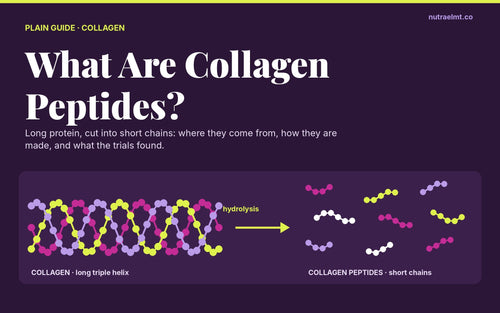
Hydrolyzed means the collagen has been cut into short chains called peptides. The 2019 review describes hydrolyzed collagen as low-molecular-weight peptides of 3 to 6 kDa, made with enzymes in an acid or alkaline medium at a set temperature. The result is still protein and is digested like any other.

A kilodalton, written kDa, is a unit of molecular mass: 1,000 daltons. A chain of 3 to 6 kDa is short compared with the long triple-helix molecule that collagen forms in the body, which is the point of the process. The finished powder dissolves more easily than gelatin and is sold as “collagen peptides,” “collagen hydrolysate” or “hydrolyzed collagen.” The three words mean the same thing.
Does hydrolyzed mean better absorbed?
Shorter chains are the reason makers give for using peptides. We cite no head-to-head trial showing that hydrolysis changes outcomes, so we regard it as a manufacturing choice, not a benefit. What is documented is narrower: a 2005 study found a small proline-hydroxyproline fragment in volunteers’ blood after they ate gelatin hydrolysate, which we describe in our article on whether collagen helps hair growth. A fragment in blood is not a result on skin, joints or hair.
Which collagen types does bovine collagen contain?
Bovine collagen from hide and bone is mostly type I, with type III also present. Marine collagen is mostly type I, and chicken sternum collagen is mostly type II. A label that says type I and III fits more than one animal, so the types alone do not name the source.

Types are numbered by structure, not by quality. Types I and III are the two that dominate skin and connective tissue, which is why they appear on so many labels. What each number means, and why “type I and III” is common, is explained in collagen type 1 and 3, explained simply.
Why type II is a different conversation
Type II is the main collagen of cartilage, and products built on it are usually sold for joints, not for skin or hair. It is a different ingredient with a different body of research, and a bottle that mixes up the two is borrowing evidence it has not earned.
What does the research on bovine collagen show?
Less than the marketing implies. A 2023 review of 26 trials found better skin hydration and elasticity with hydrolyzed collagen, while a 2025 review of 23 trials found that effect only in industry-funded and lower-quality studies. The trial abstracts we read name collagen peptides, not the animal.
Both reviews are on PubMed: Pu and colleagues, 2023, and Myung and Park, 2025. The authors of the 2025 review concluded that clinical evidence does not currently support collagen supplements for skin aging. We cite both because a reader deserves the disagreement, not only the half that sells. Our longer look at the skin and hair evidence is in does collagen help hair growth?
What did the best-known muscle trial find?
In a 2015 randomized trial by Zdzieblik and colleagues, 53 men with an average age of 72 and age-related muscle loss did 12 weeks of resistance training. Half took 15 grams a day of collagen peptides and half took a silica placebo. Fat-free mass rose by 4.2 kg in the collagen group and 2.9 kg in the placebo group, which is a real difference, but in older men, at 15 grams a day, alongside exercise.
What do these studies mean for a small daily dose?
They tell you what was tested: grams, not milligrams, usually in one specific peptide product, often with the maker involved. A result at 15 grams a day, or at 2.5 grams, says little about a capsule that holds 500 mg. That is not a criticism of the capsule; it is a reason not to quote the trials as if they described it.*
Why funding and design matter
Many collagen trials test one manufacturer’s peptide, at one dose, on an outcome the sponsor chose. That does not make them wrong. It means a result for one branded product says little about a different collagen at a different dose, and it is why the 2025 review’s split between industry-funded and other studies matters more than any single headline number.
Does “grass-fed” or “cow collagen” on a label prove anything?
Only what the document behind it shows. “Grass-fed collagen” or “cow collagen” is a claim about the animal, and a bottle’s panel rarely says which certificate supports it. Ask for the supplier’s document, and read a claim that has none as marketing.
Grass-fed is a claim about how the cattle were fed, not about the collagen molecule, which is the same protein either way. Whether the claim holds depends on paperwork: a certificate from the supplier, tied to the lot. How the phrase works on a supplement label, and where its legal edges are, is the subject of what “grass-fed” legally means on a supplement label.
What a good document looks like
It names the animal, the country of origin and the processing step, and it carries a lot number you can match to the bottle. We publish the certificates for our own organ ingredients on the Lab Tests page for that reason, and we hold collagen claims to the same standard: if there is no document, we do not make the claim.
What does the Women Bloom label say about its collagen?
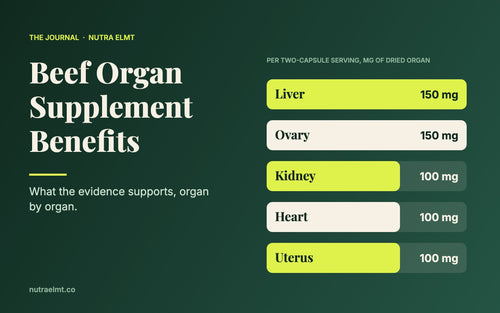
It says Collagen Peptides Type I & III, 500 mg per two-capsule serving. That collagen is bovine, from cattle, though the panel line does not name the animal; we do not yet call it grass-fed or hydrolyzed, because the supplier documentation on the process has not reached us. The five organs are labeled bovine: ovary, liver, kidney, heart and uterus, 600 mg together.
That distinction matters, and it is easy to blur. The organ powders are declared as bovine on the panel. The collagen line is declared by type and amount only; its bovine source is stated by us, not by the panel wording. Every figure is printed as text on the Supplement Facts page.
Where the collagen fits is a matter of design. The 500 mg sits beside 600 mg of organs, 10,000 mcg of biotin and 10 mg of zinc as zinc oxide in a beef organ supplement with 500 mg of collagen peptides, type I and III, beside five organs. It is a modest amount compared with the grams used in the trials above, and we do not present it as a study dose. Someone who wants collagen at those amounts is better served by a dedicated collagen powder, a comparison we make plainly in collagen powder vs beef organs.*
Can you take collagen and organs together?
Yes, they are different ingredients and nothing about one competes with the other. The practical side, including how a capsule formula and a separate powder can sit side by side, is covered in can you take collagen and beef organs together?
How should you choose a bovine collagen supplement?
Check five things: the animal named on the label, the grams per serving, whether it is hydrolyzed, the types, and a document that backs the claims. Then compare the dose with the amounts in the trials we cite, which ran from 2.5 to 15 grams a day, not a few hundred milligrams.
A five-point label check
- The animal. “Bovine,” “beef” or “cow” should appear on the label or the supplier document. “Collagen peptides” alone does not name one.
- The dose. Read grams per serving, then compare it with what the studies used.
- The form. Hydrolyzed peptides, gelatin and undenatured collagen are different materials.
- The types. Type I and III suit most skin-focused products; type II is a cartilage ingredient.
- The paperwork. A claim about origin or feeding should come with a document you can read.
Be wary of any page, ours included, that promises a result from a word on a label. Collagen is a protein, and the honest summary is that the evidence is mixed, the doses in trials are large, and the source on the bottle is information worth having. If you are pregnant, nursing or taking medication, talk to your physician before starting any supplement.
Last reviewed: 29 October 2026. This article is general information, not medical advice. Talk to your physician before starting any supplement, especially if you are pregnant or planning a pregnancy.
*These statements have not been evaluated by the Food and Drug Administration. This product is not intended to diagnose, treat, cure, or prevent any disease.
Keep reading

*These statements have not been evaluated by the Food and Drug Administration. This product is not intended to diagnose, treat, cure, or prevent any disease. This article is for informational purposes only and is not medical advice. Speak with your healthcare provider before starting any supplement, especially if you are pregnant, nursing, taking medication, or managing a medical condition.