Does Collagen Help Hair Growth? What the Studies Actually Show

Not in any way that has been clearly shown. Hair is built from keratin, not collagen, and the human trials on collagen and hair are few, small and mostly paid for by ingredient makers. Collagen’s better-studied ground is skin, and there the results split.*
This page explains what hair is made of, where collagen actually sits around the follicle, what the few trials measured, and how much collagen those trials used compared with what is in a two-capsule serving of Women Bloom.
The short version
Collagen is not what hair is made of, and no independent trial we could find shows that swallowing it grows hair. The small trials that exist mostly tested one maker’s peptide, at 2.5 grams a day or more. Women Bloom carries 500 mg, so we make no hair-growth claim for its collagen.*
What is hair actually made of?
Hair is made mostly of keratin, a protein rich in the amino acid cysteine, whose sulfur bonds give each strand its strength. Collagen is a different protein, built largely from glycine, proline and hydroxyproline, with very little cysteine. Swallowing collagen does not deliver keratin to the scalp.
That does not make collagen useless. The body breaks every dietary protein down and reuses its amino acids, so collagen counts toward total protein. It is simply not a hair-specific building block, and a label that implies otherwise goes further than the chemistry.
Why total protein still matters
Hair follicles divide quickly and draw on a steady supply of protein, iron, zinc and other nutrients. When intake is adequate, the source of one particular protein matters far less than whether the diet covers the basics. The pillar on hair, skin and nails supplements for women walks through each of those basics.
Where does collagen sit around the hair follicle?
Collagen surrounds the follicle rather than forming the strand. The dermis that anchors each follicle is mostly type I and type III collagen, and a 2016 study found that loss of type XVII collagen in follicle stem cells drove hair thinning in aging mice and human scalp tissue. That study did not test eating collagen.
Type XVII collagen is made inside those stem cells, by their own genes. It is not the collagen sold in supplements, which is types I and III. The study, by Matsumura and colleagues, is on PubMed. What the type numbers on a label mean is explained in collagen type 1 and 3, explained simply.
What happens to collagen after you swallow it?
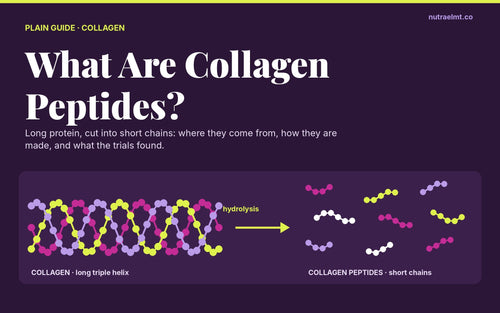
It is digested like any protein. Most of it ends up as single amino acids, and a share survives as small fragments: a 2005 study found prolyl-hydroxyproline in volunteers’ blood one to two hours after they ate 9.4 to 23 grams of gelatin hydrolysate. Where those fragments go next is still being studied.
That study, by Iwai and colleagues in the Journal of Agricultural and Food Chemistry, measured blood levels, not skin or hair. Laboratory work suggests such fragments may act as signals to skin cells, but a signal in a dish is not hair growing on a head.
What do the studies on collagen and hair show?
Very little, and none of it settles the question. The best-known hair trial gave 44 women 2.5 grams a day of one branded peptide for 16 weeks and reported thicker strands, but the ingredient maker ran and reported it. We found no independent, placebo-controlled trial of collagen alone on hair growth in women.

Nails have slightly more. In an open-label study by Hexsel and colleagues, 25 people took 2.5 grams a day of collagen peptides for 24 weeks; nail growth rose 12 percent and broken nails fell 42 percent. There was no placebo group, so part of that change may not come from the collagen.
Why funding and design matter here
Many collagen studies test one manufacturer’s peptide, at one dose, on an outcome the sponsor chose. That does not make them wrong. It means a result for one branded peptide at 2.5 grams says little about a different collagen at a different dose.
What does the larger skin research say?
It splits by who paid. A 2023 review of 26 trials and 1,721 people found better skin hydration and elasticity with hydrolyzed collagen. A 2025 review of 23 trials found the effect only in industry-funded and lower-quality studies, and none in independent or high-quality ones.
The authors of the 2025 review concluded that clinical evidence does not currently support collagen supplements for skin aging. Both reviews are on PubMed: Pu and colleagues, 2023, and Myung and Park, 2025. We cite both, because a reader deserves the disagreement rather than the half that sells.
How much collagen did the studies use?
The trials we read used 2.5 grams a day or more, and the blood-peptide study used several times that. A two-capsule serving of Women Bloom contains 500 mg of collagen peptides, type I and III, one fifth of the smallest of those doses. We do not present it as a hair dose.*

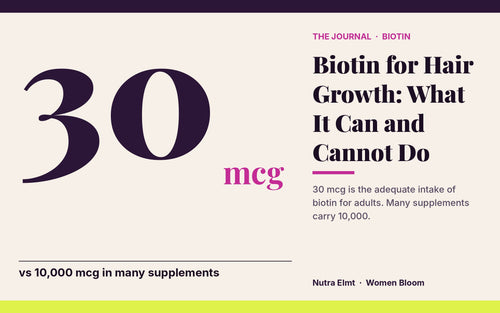
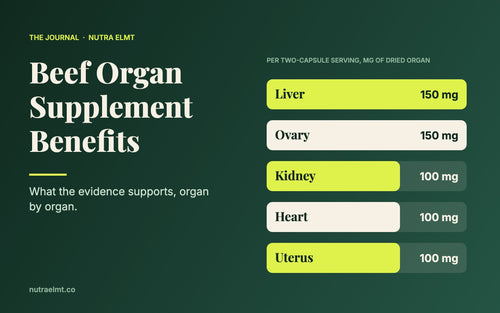
That is a design choice, not an oversight. The collagen sits beside 600 mg of organs, 10,000 mcg of biotin and 10 mg of zinc as zinc oxide in a beef organ supplement that pairs its collagen peptides with five grass-fed organs, and every amount is printed on our Supplement Facts page. The lot certificates are on the Lab Tests page. If collagen at study doses is what you want, a collagen powder is the more direct route.
How do you judge a collagen-for-hair claim?
Ask four things: how many grams the study used, which specific peptide it tested, who paid for it, and whether it measured hair growth or only thickness or shine. A claim that cannot answer all four is borrowing evidence from a different product, dose or outcome.
The same test applies to us. Our label lists 500 mg of collagen peptides and makes no hair claim for them. Biotin and zinc are on the panel for their own roles, and what a large biotin dose does and does not mean is in biotin 10,000 mcg and hair. Sudden or patchy shedding is a reason to see a dermatologist, not to change supplements.
Last reviewed: 24 October 2026. This article is general information, not medical advice. Talk to your physician before starting any supplement, especially if you are pregnant or planning a pregnancy.
*These statements have not been evaluated by the Food and Drug Administration. This product is not intended to diagnose, treat, cure, or prevent any disease.
Keep reading
*These statements have not been evaluated by the Food and Drug Administration. This product is not intended to diagnose, treat, cure, or prevent any disease. This article is for informational purposes only and is not medical advice. Speak with your healthcare provider before starting any supplement, especially if you are pregnant, nursing, taking medication, or managing a medical condition.