How Much Biotin Is in Beef Liver?

Beef liver is the food most often called a biotin powerhouse. It genuinely is the richest source on the government's own list — and it is still nowhere near the dose printed on a beauty supplement. Both facts are true, and the gap between them is the whole story.
If you are here because of a lab appointment rather than a nutrition question, start with how biotin affects blood test results instead. And if you want the doses rather than the food, we read the label of 66 supplements marketed to women and published every figure.
How much biotin is in beef liver?
Cooked beef liver contains about 30.8 mcg of biotin per 3-ounce serving — roughly 103% of the 30 mcg Daily Value — according to the NIH Office of Dietary Supplements. That makes it the single richest food source on the NIH's published table, ahead of eggs, fish and seeds.
One caution about sourcing, since it affects almost every article you will read on this subject: USDA FoodData Central does not list the biotin content of foods at all. Any figure attributed to the USDA for biotin has been mislabelled somewhere along the way. The NIH fact sheet is the citable source.
Which foods have the most biotin?
After organ meats, the leaders are eggs, fish, seeds and nuts. A whole cooked egg supplies 10 mcg, canned salmon 5 mcg per 3 ounces, sunflower seeds 2.6 mcg per quarter cup. The drop-off after liver is steep, which is why organ meats keep their reputation.

Why the numbers vary between sources
Biotin content shifts with variety, season and processing — canning reduces it, for instance. Raw egg white is a special case: it contains avidin, a protein that binds biotin and blocks its absorption. Cooking denatures avidin, so a cooked egg counts and a raw one works against you.
Is beef liver enough to meet your biotin needs?
Comfortably, yes. The Adequate Intake for adults is 30 mcg per day, and a single 3-ounce serving of liver covers it. Average intake in Western populations already runs about 35 to 70 mcg per day from food alone, which is why the NIH describes biotin deficiency as rare.
This is the part that supplement marketing tends to skip. Meeting your biotin requirement is not a difficult nutritional problem for most people eating a mixed diet.
How does that compare with a biotin supplement?
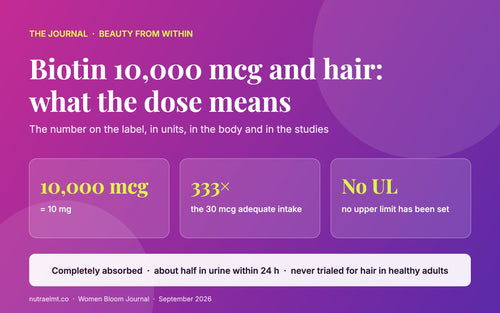
It does not compare — the two operate on different scales. A 3-ounce serving of beef liver provides about 30.8 mcg. A two-capsule serving of our own formula declares 10,000 mcg of biotin. Those are the two published figures, and we would rather set them side by side than reduce them to a marketing ratio.

Do beef organ capsules deliver meaningful biotin?
No, and this is worth saying plainly because we sell them. The biotin in a beauty formula comes from added biotin, not from the organs. A two-capsule serving of ours contains 150 mg of freeze-dried beef liver powder — a fraction of a gram, against the 85 grams in a 3-ounce portion of cooked liver.
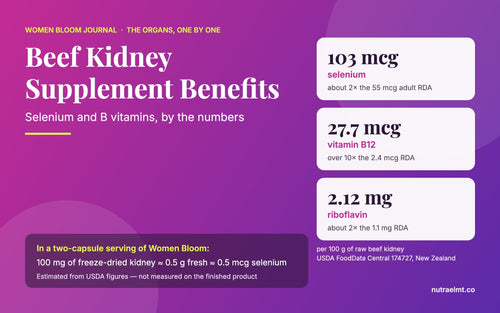
Organ meats are the best whole-food source of biotin there is — and biotin is only one line in what beef liver actually does for women. They are still not a route to a supplemental dose, and a brand implying that its organ blend delivers beauty-level biotin is relying on you not checking the serving sizes. Ours are on the Supplement Facts page, broken down organ by organ: 150 mg liver, 150 mg ovary, and 100 mg each of kidney, heart and uterus.
Our survey of the category found the same thing across the board: of 17 competitor beef organ supplements, fifteen contain no added biotin at all and the highest contains 10 mcg. The same logic applies to the other headline ingredient in these formulas — we look at whether collagen and beef organs work together, and which cofactor almost every brand leaves out.
That same serving-size arithmetic settles another question readers bring to organ capsules. We work through it, with a USDA table of what each organ carries per 100 calories, in do beef organ supplements help with weight loss.
Do you actually need 10,000 mcg?
The honest answer is that nobody has demonstrated it. The NIH's assessment is that claims for biotin on hair, nail and skin health are supported "at best, by only a few case reports and small studies" — and the brittle-nail studies that do exist used about 2.5 mg per day, not ten.*
10,000 mcg became the category standard because it is a memorable number on a label, not because it was established as the effective dose. We proved that to ourselves the hard way: when we read the panel of 66 women's supplements, the doses landed on a handful of round numbers — 14 products at exactly 5,000 mcg, 10 at exactly 2,500, six at exactly 10,000. A dose arrived at by research would scatter.
One consequence is not optional reading: high-dose biotin interferes with several common laboratory tests. That is covered in detail on our page about biotin and blood tests, and it is the reason the warning appears on our label.
How common is biotin deficiency?
Rare. The NIH notes that severe biotin deficiency in healthy people eating a normal mixed diet has never been reported. Where it does occur, it is linked to specific causes: biotinidase deficiency, a genetic disorder screened for at birth; chronic alcohol exposure; and long-term anticonvulsant therapy, which accelerates biotin breakdown.
Pregnancy is a partial exception — at least a third of pregnant women develop marginal biotin deficiency despite normal intakes, though the NIH is explicit that the clinical significance of that finding is not yet understood. If you are pregnant or nursing, supplement decisions belong with your healthcare provider. Relevant research is indexed on PubMed, and the FDA maintains general guidance on supplement use.
The short version
Beef liver provides about 30.8 mcg of biotin per 3-ounce serving, slightly above the 30 mcg Daily Value and more than any other food on the NIH list. That is enough to meet a daily requirement and nothing like a supplemental dose. The biotin in an organ-based beauty formula comes from added biotin, not from the liver in the capsule — and the evidence that 10,000 mcg outperforms a far smaller dose has not been produced.*
If you want the food and the supplemental dose in the same capsule, with both amounts printed rather than implied, that is what Women Bloom is: five New Zealand grass-fed organs named one by one, plus collagen, biotin and zinc.*
Last reviewed: August 2026.
*These statements have not been evaluated by the Food and Drug Administration. This product is not intended to diagnose, treat, cure, or prevent any disease.
Keep reading
*These statements have not been evaluated by the Food and Drug Administration. This product is not intended to diagnose, treat, cure, or prevent any disease. This article is for informational purposes only and is not medical advice. Speak with your healthcare provider before starting any supplement, especially if you are pregnant, nursing, taking medication, or managing a medical condition.