Do Beef Organ Supplements Help With Weight Loss?

No — not directly. No controlled trial has shown that a beef organ supplement reduces body weight. What organ meat does offer is nutrient density per calorie, which is a different subject. A two-capsule serving weighs about 1.1 grams and carries roughly four calories.
The honest answer fits in a paragraph. What follows is the arithmetic behind it, the USDA numbers that make organ meat interesting for other reasons, and the exact point where the evidence stops. We sell a beef organ supplement, so treat this page as checkable rather than as advice: every figure below comes from our own published label or from a source you can open in a new tab.
Do beef organ supplements help with weight loss?
No. No published controlled trial has tested a beef organ supplement against body weight, so there is nothing to report in either direction. What can be stated is the arithmetic: a two-capsule serving contains 600 mg of organ powder, and 600 mg of anything cannot create a calorie deficit.
That is an unusual thing for a supplement brand to write, and we would rather write it than let a reader buy our product for a reason it cannot deliver. Body weight is governed by energy intake and expenditure sustained over months. A capsule that weighs about as much as a grain of rice does not enter that equation on either side.
Where organ meat is genuinely interesting is a separate question: how much nutrition it carries for each calorie it costs. That question has real USDA numbers behind it, and they are below.
What are people actually asking when they search this?
Three different questions hide behind one search. Someone typing beef organ for weight loss may be asking whether the capsules burn calories, whether organ meat fits inside a reduced-calorie diet, or whether feeling exhausted on a diet is a nutrient problem. Only the first has a flat no for an answer.
The second question is reasonable and has a reasonable answer: organ meat is unusually nutrient-dense per calorie, which is a useful property when you are eating less food overall. The third is a medical question that a blood test answers and a label cannot.
People also search beef organ supplement weight loss after seeing a claim somewhere and wanting to check it. If that is you, the sections below are a method for checking that kind of claim on any bottle in this category, not only on ours.
What do beef organs contain, per calorie?
Per 100 calories, beef liver carries 15.1 g of protein, 43.9 mcg of vitamin B12, 7.2 mg of copper and 2.0 mg of riboflavin. Lean top sirloin, at the same 100 calories, carries 16.9 g of protein but only 0.8 mcg of B12, 0.06 mg of copper and 0.09 mg of riboflavin. The protein is nearly identical; almost everything else is not.

That table is the whole nutritional case for organ meat, and it is also the reason the weight question comes out the way it does. If organs and steak deliver roughly the same protein per calorie, then organs carry no special advantage on the one mechanism — protein — that actually links food to appetite and body weight in the research.
What the columns are good for
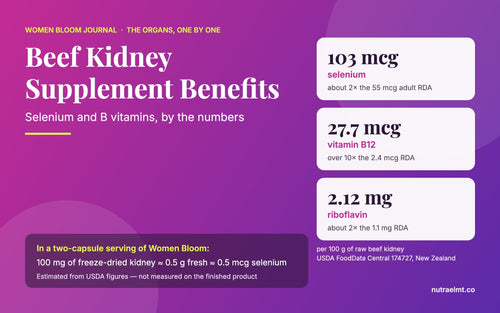
Kidney is the outlier on selenium, at about 142 mcg per 100 calories against 21 mcg for steak. Liver is the outlier on copper, vitamin A and B12. Heart sits between them, with roughly nine times the B12 of steak per calorie and none of the vitamin A. These are meaningful differences for a diet, and none of them is a weight mechanism.
All of these figures are for raw tissue and can be checked directly: the liver entry is at USDA FoodData Central, and the other three carry the ID numbers given in the caption.
Where exactly does the evidence stop?
It stops at three specific places, and it is worth naming them. There is no controlled trial of any beef organ supplement against body weight. The protein and satiety research uses whole foods in amounts far larger than two capsules. And no capsule substitutes for an energy deficit. Everything past those three lines is marketing.

The NIH Office of Dietary Supplements is blunt about the wider category: there is little scientific evidence that products sold for weight loss work, many are expensive, some can interact with medications, and a few might be harmful. Its fact sheet on dietary supplements for weight loss works through the ingredients that are actually marketed for this — green tea extract, garcinia, chromium, conjugated linoleic acid and a dozen more — and reports what the trials found for each one. Beef organs are not on that list, because nobody has run the trials.
We would rather say that plainly than imply a result we cannot show. It is the same standard we applied to ourselves in our audit of 59 beef organ supplements, where Women Bloom failed one of the four criteria and the failing score was left in the dataset.
What does a two-capsule serving actually provide?
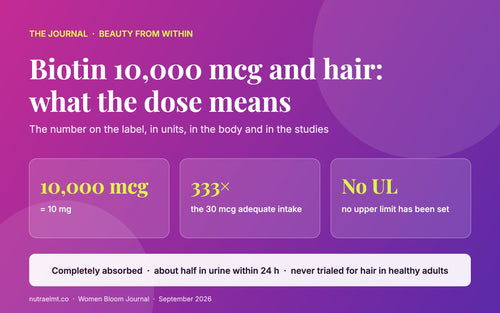
Two capsules carry 600 mg of freeze-dried organs — 150 mg each of bovine liver and ovary, 100 mg each of kidney, heart and uterus — plus 500 mg of collagen peptides type I & III, 10,000 mcg of biotin and 10 mg of zinc.* That is about 1.1 grams of material in total, before the gelatin capsule shell.
Freeze-drying removes water, so the powder is more concentrated than the fresh organ it came from — but not by enough to change the picture. USDA FoodData Central records raw beef liver as 70.8% water, so 600 mg of freeze-dried organ corresponds to roughly two grams of fresh tissue: smaller than a single bite, and worth about four calories.
Two grams of liver is a serious delivery vehicle for micronutrients, which are measured in milligrams and micrograms. It is not a meaningful amount of food, which is measured in tens and hundreds of grams. Both things are true at once, and confusing them is where most supplement overclaiming begins. Two of the five organs in that list are ones almost no brand bothers to explain — start with what beef uterus actually is — and the full panel, every dose in text, is on the Supplement Facts page.
Does protein help with weight management, and does 600 mg count?
Protein does, at the scale of a whole diet. A 2021 systematic review and meta-analysis of 37 randomised controlled trials found that participants who raised protein intake — to between 18% and 59% of daily calories — reduced body weight by 1.6 kg compared with controls. Those interventions moved tens of grams of protein a day, not fractions of one gram.
You can read the meta-analysis abstract on PubMed. Its authors describe the effect as moderate, which is a fair word for 1.6 kg across trials running from weeks to months. It is also an effect produced by breakfast, lunch and dinner, not by a capsule.
Why a capsule is not a scoop
The same limit applies to the collagen in our own formula. A two-capsule serving carries 500 mg of collagen peptides, against the 2.5 to 10 grams used in most collagen research — a gap we set out in full in collagen powder versus beef organs, which compares the two formats on USDA data. Capsules are good at delivering small, potent things. They are poor at delivering grams, and appetite research runs on grams.
Could feeling tired be a nutrient question rather than a willpower question?
Sometimes, and that is a question for a blood test rather than a supplement label. Iron, B12 and other nutrients contribute to normal energy-yielding metabolism,* but only a clinician can tell you whether yours are low. A supplement bought on a hunch is answering a question nobody has actually asked yet.
If you do get bloodwork, one thing is worth knowing first: high-dose biotin can distort several common laboratory assays, including thyroid and troponin tests, which is why we published a full article on biotin and blood test interference rather than burying it in a footnote. Tell whoever draws your blood what you are taking, ours included.
Why do some products imply a supplement will change your weight?
Because the vocabulary is free and the implication is hard to check on a single bottle. Phrases like metabolism support, thermogenic and detox are not defined by any regulator, so they can appear on a label with no study behind them. A specific number — 600 mg, 1.6 kg, 70.8% water — is much harder to write without data.
There is a sharper reason for caution. The FDA advises consumers to be especially wary of products sold for weight loss, and has repeatedly found undeclared prescription drug ingredients, including the banned drug sibutramine, in products advertised as all-natural. Its guidance on avoiding products contaminated with hidden ingredients is worth five minutes before any purchase in this category. When a supplement produces a dramatic effect on body weight, the most likely explanation is that something is in it that is not on the label.
What does the Women Bloom label claim, and what does it not?
The label makes structure-function statements about zinc, biotin and collagen, each carrying an asterisk, and it makes no claim about body weight, appetite or fat. A supplement may describe how a nutrient supports the normal structure or function of the body. It may not claim to treat, prevent or cure anything, and body weight is not among the things it is permitted to promise.

One thing our own label does not tell you
Women Bloom declares biotin, zinc and collagen in text, along with a milligram figure for each of the five organs. It does not declare an iron or a vitamin B12 amount, because we have not run a finished-product assay for either. Beef liver is naturally a rich source of both, as the per-calorie table above shows, but we are not going to publish a figure for our own product that we cannot show you a certificate for. The certificates we do have — including the finished-product assay on lot 0125252, where every organ came back at 100% of its label claim — are on the Lab Tests page.
What actually changes the number on the scale?
An energy deficit sustained over months, with enough protein and enough sleep to hold on to muscle while it happens. That is unglamorous, and it is the thing the evidence supports most consistently. If a weight goal matters to you, a registered dietitian or your own doctor is a better first purchase than any capsule.
Where a supplement can sit in that picture is as nutritional cover, not as a lever. Eating less food means taking in fewer nutrients, and the per-calorie table above is exactly the argument for keeping nutrient-dense foods in a reduced-calorie diet. That is a reason to eat liver. It is not a reason the diet works.
Who is a beef organ supplement actually for?
It is for someone who wants the nutrients concentrated in organ meat without eating organ meat, and it is bought on nutrition grounds rather than weight grounds. Women Bloom is formulated around energy, women's balance, and skin, hair and nail support* — not around body weight, and we will not sell it as though it were.
If you are shopping in this category, apply one test to every bottle including ours: does the label tell you how many milligrams of each organ you are getting? In our audit of 59 products from 43 brands, 17 of the 40 multi-organ products published no readable per-organ amounts at all. That single question separates products faster than any claim on the front of a bottle, and we applied it to a named competitor in looking for a Primal Queen alternative?
Women Bloom is five New Zealand grass-fed organs, each named and dosed on the label, with collagen, biotin and zinc alongside them.*
Last reviewed: August 2026. This article is general information, not medical or dietary advice. Talk to your doctor or a registered dietitian before starting any supplement, particularly if you are pregnant, breastfeeding, taking medication or managing a health condition.
*These statements have not been evaluated by the Food and Drug Administration. This product is not intended to diagnose, treat, cure, or prevent any disease.
Keep reading
*These statements have not been evaluated by the Food and Drug Administration. This product is not intended to diagnose, treat, cure, or prevent any disease. This article is for informational purposes only and is not medical advice. Speak with your healthcare provider before starting any supplement, especially if you are pregnant, nursing, taking medication, or managing a medical condition.