We Audited 59 Beef Organ Supplements. Here's What Their Labels Actually Reveal.

Buying a beef organ supplement online means trusting a label you often cannot read. Between 1 and 8 August 2026 we pulled the live product pages for 59 beef organ supplements sold by 43 brands in the United States and scored each one against four disclosures a buyer can check before paying.
Twenty-one of 59 — 35.6% — cleared the three disclosures we could check on every product. Eight cleared none of them.
We went in expecting the story to be proprietary blends. It was not. This page is the editorial summary; the complete dataset, with a source link for every row, is published as The Beef Organ Supplement Label Transparency Index 2026.
What exactly did we measure?
Four disclosures, each one checkable by a buyer before purchase, none of them requiring an email to the company. Whether the per-serving organ amounts appear as readable text; whether a cattle-origin country is named; whether a drying method is named; and whether a certificate of analysis can be opened without asking.
Fifty-nine products from 43 brands, split into three segments: 21 flagship direct-to-consumer ancestral brands, 22 retail and marketplace products, and 16 products marketed specifically to women. Every row rests on a page we actually retrieved. Where a value could not be read it was recorded as unknown and excluded from that metric rather than estimated.
What did we find?
Disclosure is the exception on the measure that matters most. Only 34 of 59 products publish their organ amounts as readable text. Origin fares slightly better at 36 of 59, drying method best at 43 of 59, and a public certificate of analysis worst of all — 16 of the 37 products where the question could be settled.

The gap between segments is wide and consistent. Flagship direct-to-consumer brands average 2.48 disclosures out of three. Retail and marketplace products average 1.59. Products marketed to women average 1.62.
Nine products cleared all four criteria: One Earth Health on four separate products, plus Perfect Supplements, Double Wood, Primal Being, and MK Supplements on two products. They are worth naming because publishing a certificate is a choice nobody made them make.
Correction, 22 August 2026
Two rows were scored wrongly and have been corrected. MK Supplements Grass-Fed Beef Liver and Grass-Fed Beef Organs were recorded as publishing no certificate of analysis. They do — the test results sit below the add-to-cart button on each product page. Our collection script read the page HTML without executing JavaScript, so that section was never in the text we scored.
The error was pointed out by Michael Kummer, who co-owns MK Supplements, within thirty minutes of our contacting him. The certificate pass rate rises from 14 of 37 to 16 of 37, and the number of products clearing all four criteria rises from seven to nine. We then re-checked every one of the 23 products scored as failing that criterion, reading each page as a browser renders it. These two rows were the only errors.
Are proprietary blends the real problem?
No, and this is the finding that surprised us. Of the 40 multi-organ products in the set, only four hid their per-organ amounts behind a proprietary blend. Among the 23 multi-organ products whose Supplement Facts panel we could read at all, that is 17.4%.
The problem sits one layer earlier. Seventeen of those 40 multi-organ products — 42.5% — publish no per-serving organ amounts in readable text at all. Not a blend total. Nothing. The panel is either absent from the page or exists only as a flat image with no text equivalent.
One of those seventeen is among the most visible women's beef organ brands. We set its published label against ours, figure by figure, in looking for a Primal Queen alternative.

Why a blend is better than nothing
A proprietary blend, for all its faults, still tells you the total, and federal law makes sure of it. 21 CFR 101.36(c)(3) requires the quantitative amount by weight of a proprietary blend to be the total weight of everything in it, with the ingredients listed in descending order of predominance.
So a blend gives you a ceiling and an ordering. You know the maximum, and you know which organ dominates. A missing panel gives you a marketing paragraph.
Why does a readable online panel matter?
Because three different readers depend on it, and two of them cannot see an image. A shopper comparing two bottles needs the numbers to compare. A screen reader user needs text, not pixels. And an AI shopping assistant asked which beef organ supplement has the most liver reads the page the same way a screen reader does.
That last one has changed the stakes. A product whose amounts exist only inside a JPEG is, for practical purposes, undisclosed to every automated system that now sits between a question and a purchase. It may be perfectly printed on the physical bottle — but the bottle is not what anyone consults before buying.
It also makes the arithmetic impossible
“3,000 mg of beef organs” is not one product. It is a family of products with materially different compositions, and without per-organ numbers you cannot tell which one you are holding. For 25 of the 59 products we could not even compute cost per gram, because the label arithmetic is not published. A category that hides its denominators cannot be price-compared.
Are women-marketed products less transparent?
Yes, on the disclosure that matters most. Eleven of the 16 women-marketed products — 68.8% — publish no readable organ amounts, against 14.3% of flagship direct-to-consumer products and 50.0% of retail products. Only 31.2% of the women's segment passed the dose-transparency test, the worst score of any segment on any criterion in the study.
The segment is not uniformly worse. It leads on drying method, where 81.2% name one, and sits mid-pack on origin. But it is where marketing most often substitutes for numbers.
One caveat we want on the record: 16 products is a small sample, and a difference of this size should be read as a signal to investigate rather than a settled fact.
Does US law require any of this?
Largely no — which is the honest frame for everything above. Nothing in 21 CFR 101.36(c) requires the individual amount of each ingredient inside a blend. On country of origin, FDA Compliance Policy Guide Sec. 560.200 states that a country-of-origin statement on the labeling of imported foods is not required by the Federal Food, Drug & Cosmetic Act.
On lab testing the split is sharp and worth stating precisely. Testing is mandatory — 21 CFR 111.75 requires at least one test to verify the identity of any dietary ingredient. Publishing the results is not. The only records-availability provision in the whole of 21 CFR Part 111 requires records be readily available for inspection by the FDA. The FDA, not you.
Every published certificate in this dataset is therefore a marketing choice, not a compliance act — and a document you can read line by line. That is exactly what makes it worth measuring.
How did our own product score?
Badly on the criterion we talk about most, and we are publishing that. Women Bloom is our own five-organ formula. It was audited by the same rules as every other product. It passed on origin, on drying method and on publishing a certificate — and it failed on readable organ amounts, because our Supplement Facts panel existed only as an image.
Our own page said there were no proprietary blends and no hidden amounts. Measured the way we measured everyone else, that claim was not supported by anything a reader — or a screen reader — could retrieve. It would have been easy to quietly score ourselves a pass.
Update, 8 August 2026
The failure was found during this audit and fixed the same day. The per-organ amounts are now published as accessible text on both the product page and the Supplement Facts page: bovine liver 150 mg, bovine ovary 150 mg, bovine kidney 100 mg, bovine heart 100 mg and bovine uterus 100 mg, for 600 mg of organs in a two-capsule serving. Certificates remain published on our Lab Tests page.
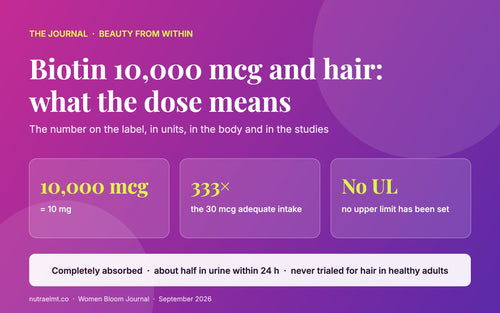
The dataset has not been re-scored. It preserves the August 2026 reading, including our failure, so the study stays checkable — as does our own cost per gram of organ, roughly six times the category median, in the Primal Queen comparison. This is the second time we have published something unflattering about our own label — the first was our survey of biotin doses in 66 women's supplements, where our own dose came out second-highest.
What does this study not show?
It measures transparency, not quality, and certainly not effectiveness. We did not assay a single capsule. A product that discloses nothing may be excellent; a product that discloses everything may be mediocre. This study measures what buyers are told, not whether it is true.
Three more limits worth knowing. Readable as text is what we measured, not disclosed — a product may print complete amounts on the physical bottle. Amazon blocks automated retrieval, so no row rests on an Amazon listing, and the marketplace long tail is under-represented. And prices are list prices from the first week of August 2026, before subscription discounts.
Where is the full dataset?
All 59 rows, with the source URL for every product we scored, are published in full. Nothing is behind an email form and nothing is summarised away.
→ Read the complete Beef Organ Supplement Label Transparency Index 2026 — methodology, segment breakdowns, cost-per-gram analysis, and the full table.
The data is free to use with attribution. Journalists, researchers and competitors are welcome to check our coding against the source URLs, including the row where we failed and the two rows we got wrong.
Cite as: Beef Organ Supplement Label Transparency Index 2026, The Nutra Elmt Journal, August 2026.
Last reviewed: 22 August 2026.
These statements have not been evaluated by the Food and Drug Administration. This product is not intended to diagnose, treat, cure, or prevent any disease.
Keep reading
*These statements have not been evaluated by the Food and Drug Administration. This product is not intended to diagnose, treat, cure, or prevent any disease. This article is for informational purposes only and is not medical advice. Speak with your healthcare provider before starting any supplement, especially if you are pregnant, nursing, taking medication, or managing a medical condition.