Iron, Energy and Women’s Nutrition: What Actually Matters

Energy comes from food, not vitamins. Iron and vitamin B12 matter for energy only when intake or stores run low, and a blood test, not a capsule, shows which case applies. For most women the useful question is whether one of them is short.
This is the hub page for that question. It covers what iron and B12 actually do, the one trial that tested iron for tiredness in women who were not anemic, what beef organs supply as food, and what Women Bloom’s own label does and does not contain. It also says where the evidence stops.
What does “energy” actually mean in nutrition?
In nutrition, energy means calories: the fuel in carbohydrate, fat and protein. Vitamins and minerals contain none. They work as cofactors and building blocks in the reactions that release that fuel and carry oxygen to it. So no nutrient “gives” energy; a shortage of one can limit how well the machinery runs.*

That framing is why a label promising to “boost energy” deserves a second look. Two nutrients come up most often for women. Iron is a component of hemoglobin, the red blood cell protein that carries oxygen from the lungs to the tissues, and of myoglobin in muscle, according to the NIH Office of Dietary Supplements. Vitamin B12 is a cofactor in DNA synthesis and in the formation of healthy red blood cells, per the NIH’s B12 fact sheet.*
Both roles are about supply lines rather than fuel. Iron helps oxygen travel; B12 helps the cells that carry it get made. When either runs short, the supply line narrows, and tiredness is one of the documented consequences. When neither is short, adding more does not widen a line that was already open. That single distinction organizes everything else on this page.
Why is a woman’s iron need higher than a man’s until age 51?
The NIH sets the recommended daily iron intake at 18 mg for women aged 19 to 50, against 8 mg for men and for women 51 and older. The higher figure reflects iron lost in menstrual blood each month, which the diet has to replace. After menopause that loss stops and the recommendation falls to 8 mg.
The NIH lists premenopausal women among the groups at risk of not getting enough iron, and heavy menstrual bleeding as a specific risk factor; at least 10% of menstruating women are believed to have menorrhagia. Women with heavy bleeding lose significantly more iron per cycle than women with normal bleeding, so the average figure of 18 mg is not a personal one.
The other side of the number matters just as much. The tolerable upper intake level for adults is 45 mg a day, so more is not better, and the drop from 18 mg to 8 mg at 51 changes what an iron-rich food or supplement is for. We work through that shift in what organ supplements can and cannot offer in perimenopause. And because the requirement is set for the whole month rather than by cycle phase, nutrition across the menstrual cycle explains why “eat more iron in week one” is not something the recommendations say.
Can low iron cause tiredness even when you are not anemic?
In one randomized trial, partly yes. Among 198 non-anemic women with unexplained fatigue and ferritin below 50 µg/L, 80 mg of elemental iron a day for 12 weeks lowered fatigue scores by 47.7%, versus 28.8% on placebo. The finding applies to women who are actually low in iron, not to women in general.
The trial, Vaucher et al., published in CMAJ in 2012, recruited women aged 18 to 53 from 44 primary care practices in France. Everyone had a hemoglobin above 12.0 g/dL, so none met the definition of anemia, and everyone had a low ferritin, the blood marker of stored iron.

How to read the result honestly
The placebo group improved by nearly 29%, so the net difference was 18.9 percentage points, with a 95% confidence interval of 3.2 to 34.5. That is a real signal and a wide one. Iron did not change quality of life, depression or anxiety scores. It did raise hemoglobin by 0.32 g/dL and ferritin by 11.4 µg/L compared with placebo. The authors concluded that iron should be considered for women with unexplained fatigue and ferritin below 50 µg/L, and suggested checking blood markers after six weeks.
What the trial cannot tell you
It tested a medicinal iron salt, not food and not an organ powder, and 80 mg a day is well above the 45 mg upper intake level the NIH sets for adults. The NIH’s own threshold is also lower: a ferritin below 30 µg/L suggests iron deficiency. Those gaps are the reason this belongs in a conversation with a clinician who has your ferritin result, not in a guess made in a supplement aisle. This page is general information, not medical advice.
Does vitamin B12 give you energy?
Only by correcting a shortage. The NIH concludes that B12 supplementation shows no performance benefit in people who are not deficient. B12 is required for healthy red blood cell formation, so a true deficiency can bring fatigue; extra B12 in someone who already has enough does not add fuel.*
The recommended intake is 2.4 mcg a day for adults. B12 is unusual because absorption depends on a protein made in the stomach, intrinsic factor, and the NIH notes that absorption drops markedly once that capacity is exceeded, at around 1 to 2 mcg per dose. The NIH lists older adults, people with pernicious anemia, people with gastrointestinal disorders or surgery, and people who eat no animal foods among those at risk of a low level. For several of those groups the limiting step is absorption rather than intake, which is a matter for a clinician and a blood test.
The NIH also lists fatigue among the effects of B12 deficiency, alongside anemia, so the tiredness link is real when a deficiency is. What the evidence does not support is the reverse: the popular idea that a B12 supplement or injection lifts energy in a person whose level is normal.
How can food choices change how much iron you absorb?
Iron from meat, called heme iron, is absorbed better than iron from plants. The NIH puts absorption at about 14% to 18% from mixed diets that include meat, seafood and vitamin C, and 5% to 12% from vegetarian diets. Vitamin C taken with a meal also raises the absorption of plant iron.
Those are diet-level averages, not promises for any one meal. Absorption also tends to rise when body stores are low and fall when they are full, which is the body’s own way of regulating a mineral it has no easy way to excrete. That regulation is one reason the upper limit exists and one reason a high-iron food is not automatically a high-iron delivery.
We go through the heme question in more detail, including which organ carries the iron and what a capsule serving holds, in the iron guide for women considering organ supplements. The point for this page is narrower: what you eat and when you eat it moves iron absorption by tens of percent, which is a bigger lever than most capsules pull.
What do beef organs supply as food?
Raw beef liver, per 100 grams, holds 4.9 mg of iron and 59.3 mcg of vitamin B12 according to USDA data, against daily needs of 18 mg and 2.4 mcg for a woman aged 19 to 50. As a food, liver is among the densest sources of both. A capsule is not a serving of food.

The NIH’s own table agrees in kind: a 3-ounce portion of pan-fried liver provides 5 mg of iron, 28% of the Daily Value, and 70.7 mcg of vitamin B12. Those numbers describe an animal food eaten in servings measured in ounces. They are the reason liver has a reputation, and the reason we wrote separately about what beef liver does for women and about how much liver a day is sensible.
The other organs have their own profiles, and none of them is an “energy organ.” Kidney is the selenium organ, covered in beef kidney by the numbers. Heart is the one most often tied to energy claims because it contains coenzyme Q10; what a heart supplement actually delivers weighs that claim against the dose.
Does Women Bloom supply iron or vitamin B12?
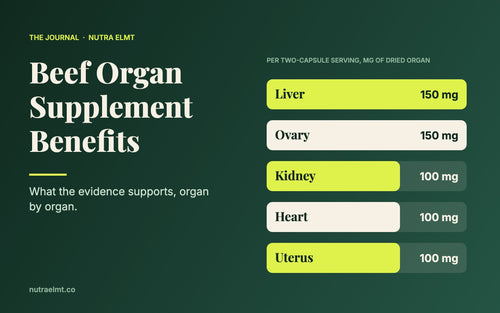
No, and the label says so by omission. The Supplement Facts panel for Women Bloom declares no iron and no vitamin B12. A serving of two capsules holds 600 mg of five bovine organ powders, 150 mg of it liver, plus collagen, biotin and zinc. We do not print a number we have not assayed.
The Supplement Facts page shows every ingredient and dose, and the Lab Tests page documents origin and certificates, not iron or B12 content. A serving’s 150 mg of freeze-dried liver powder is a fraction of a gram, while the USDA figures above describe 100 grams of raw liver. Scaling one up to the other would be a guess dressed as a fact, so we do not do it.
That is also why we do not position Women Bloom as an iron or B12 product. It is a whole-food organ formula alongside collagen, biotin and zinc, and the things we can say about it stay with what is printed on the panel. If a blood test shows low ferritin or low B12, that result belongs with your clinician, whatever you take.
Is there evidence that beef organ supplements raise energy?
We have not found a randomized trial of a freeze-dried beef organ blend on energy or fatigue in women. The evidence is about specific nutrients in people who are low in them, such as iron and B12, not about organ powders as a category. Anything stronger would be a claim we cannot back.
What exists is indirect. The iron trial above tested a medicinal iron salt in women with low ferritin. The NIH B12 review found no performance benefit without a deficiency. USDA tables show liver is rich in both nutrients as a food. Each of those is true, and none of them shows that a 600 mg blend of five organ powders changes how energetic a woman feels.
The honest position is a narrow one. An organ supplement can contribute whole-food ingredients and, in our case, documented New Zealand origin; it cannot be assumed to do what a measured dose of a single nutrient does in a trial. The wider case for and against the category is laid out in our guide to beef organ supplements for women, including the parts that do not favor us.
What else affects energy that nutrition cannot fix?
Sleep, thyroid function, medications, mood, infections and many other conditions can cause tiredness, and most are not nutritional. Persistent fatigue is a reason to see a clinician before it is a reason to buy a supplement. The NIH lists fatigue among the effects of iron deficiency anemia, but fatigue alone does not point to iron.
That last sentence is the one most supplement pages leave out. Fatigue is one of the most common complaints in primary care and has a long list of causes; nutrient shortfalls are on the list, not at the top of it by default. A page that funnels every tired reader toward a nutrient is selling certainty that the evidence does not contain.
There is also a practical cost to guessing. Iron above the upper limit can cause harm, and a supplement taken in advance of testing can blur the picture the test is meant to show. Getting the blood work first, then deciding, is the order that protects both your health and your money.
What should you ask a clinician to check?
Ask about a complete blood count and a ferritin test for iron status, and a vitamin B12 test if you are in an at-risk group. The NIH regards ferritin below 30 µg/L as suggesting iron deficiency; the trial above used 50 µg/L. Your clinician reads the numbers against your history and your cycle.
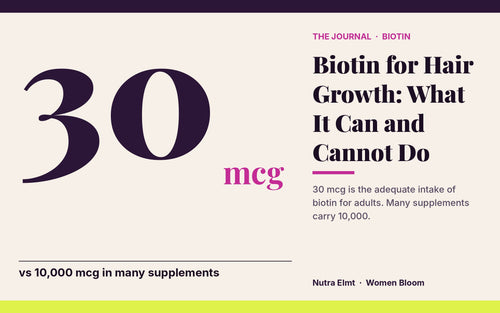
Bring a list of everything you take, supplements included. That matters for a specific reason: biotin in high doses can interfere with certain lab tests, including some immunoassays, and Women Bloom contains 10,000 mcg of biotin per serving. There is nothing alarming in that; it is a scheduling and communication detail. Tell whoever orders your blood work, and ask whether to pause the supplement before the draw. The mechanism and the practical steps are in biotin and blood tests: what to tell your doctor.
If the result is low, the next question is why, not which product. Heavy periods, diet, absorption problems and pregnancy are different situations with different answers, and that sorting is precisely the work a clinician does and a blog cannot.
The short version
Energy in nutrition means calories, and no vitamin supplies it. Iron and B12 matter when they run low: iron for women whose ferritin is low, including some who are not anemic, and B12 for women in at-risk groups. Food, notably liver, is rich in both. Women Bloom declares neither, does not claim to fix low iron or B12, and the evidence for organ powders on energy is absent rather than negative. A blood test should come before any supplement.
Last reviewed: 30 September 2026. This article is general information, not medical advice.
*These statements have not been evaluated by the Food and Drug Administration. This product is not intended to diagnose, treat, cure, or prevent any disease.
Keep reading
*These statements have not been evaluated by the Food and Drug Administration. This product is not intended to diagnose, treat, cure, or prevent any disease. This article is for informational purposes only and is not medical advice. Speak with your healthcare provider before starting any supplement, especially if you are pregnant, nursing, taking medication, or managing a medical condition.