Beef Kidney Supplement Benefits: Selenium and B Vitamins, by the Numbers

A beef kidney supplement is a small dose of the organ that USDA data ranks richest in selenium among common beef organs, with vitamin B12 and riboflavin alongside. At 100 mg per serving those amounts are modest, and the honest benefit is nutritional, not therapeutic.
This page is one of the organ-by-organ satellites of our complete guide to beef organ supplements for women. Kidney is sold on an enzyme nobody has measured, so this article sticks to what can be: USDA and NIH figures, the arithmetic for a 100 mg capsule, and a plain answer on the enzyme.
What is beef kidney, nutritionally?
Beef kidney is a lean organ — 80.5 percent water, 15.7 g of protein and 2.6 g of fat per 100 grams raw in the USDA entry for New Zealand kidney — whose standout lines are selenium at 103 mcg, vitamin B12 at 27.7 mcg and riboflavin at 2.12 mg. Its 89 mcg of vitamin A is under a fiftieth of liver’s. That last line is why kidney is in our formula at all.

The figures come from the USDA entry for New Zealand beef kidney, the same origin as the kidney in our formula. The US entry (169449) reads higher on several lines — 141 mcg of selenium, 2.84 mg of riboflavin, 419 mcg of vitamin A — selenium in an animal’s organs reflects its feed and soil, so origin moves the number. The rest of liver’s table is in beef liver benefits for women; heart’s is in beef heart and CoQ10.
Why is beef kidney called the selenium organ?
Because among the beef organs USDA lists, kidney carries the most selenium by a wide margin: 103 mcg per 100 g raw in the New Zealand entry and 141 mcg in the US entry, against 39.7 mcg for liver and 9 mcg for heart. One hundred grams of raw kidney covers about twice the 55 mcg adult RDA.
Selenium is a constituent of 25 selenoproteins, including the glutathione peroxidases, which take part in thyroid hormone metabolism, DNA synthesis, reproduction and the body’s defense against oxidative damage.* The NIH Office of Dietary Supplements puts the recommended intake at 55 to 70 mcg a day for adults, and adds the sentence that matters here: most people in the United States already consume adequate amounts. A kidney capsule tops up a mineral the average reader is not short of — the boundary of what it can do.
What about the B vitamins?
Kidney is also dense in vitamin B12 — 27.7 mcg per 100 g against the 2.4 to 2.8 mcg a day for adults on the NIH B12 fact sheet — and in riboflavin, at 2.12 mg against an RDA of 1.1 mg for women aged 19 to 50 on the NIH riboflavin fact sheet, which names kidneys and liver among the foods richest in it. Both are coenzymes in energy metabolism.* On iron, kidney and liver share the 4 to 5 mg band, as shown in do beef organ supplements help with iron.
How much selenium and B12 does a beef kidney capsule deliver?
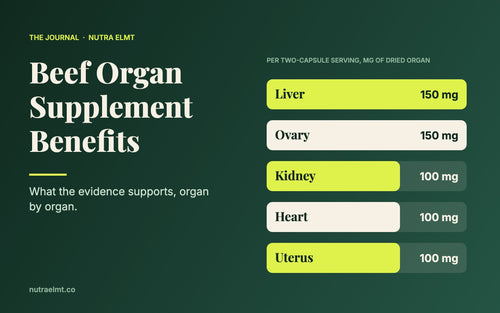
The 100 mg of freeze-dried kidney in a two-capsule serving of Women Bloom is about 0.5 g of fresh kidney, which holds 0.5 mcg of selenium, 0.14 mcg of vitamin B12 and 0.011 mg of riboflavin — about one, six and one percent of an adult woman’s daily allowance. These are estimates from USDA figures, not measured on the finished product.

USDA gives raw New Zealand kidney as 80.5 percent water, so 100 mg of dried powder began as about 513 mg of tissue — assuming drying loses nothing, the most generous assumption available. Multiply by the per-gram figures and you get 0.53 mcg of selenium, 0.14 mcg of B12 and 0.011 mg of riboflavin; on the US entry, 0.64 mcg of selenium. Our finished-product certificate confirms the kidney powder’s identity and weight by FTIR and assays neither nutrient, so we print no nutrient figures for our organs — see how to read a supplement COA.
What a six-capsule, all-kidney product would deliver
Scale the same arithmetic to the 3,000 mg serving most single-organ products use and the fresh equivalent is about 15 g of kidney: roughly 16 mcg of selenium, 4.3 mcg of B12 and 0.33 mg of riboflavin, or 29, 178 and 30 percent of the RDAs. The B12 is a real dose; the selenium is still under a third of a day’s allowance; 85 g of kidney eaten as food beats all three. Why most products sit at 3,000 mg and ours at 600 mg is in beef organ supplement dosage.
Does a beef kidney supplement supply DAO for histamine?
Nobody has published a measurement of DAO activity in a freeze-dried beef kidney capsule, and no human trial has tested one, so the honest answer is that it is unknown. Kidney tissue does contain diamine oxidase, the enzyme that breaks down histamine, which is where the marketing comes from. We make no histamine claim for our product.
The claim’s chain — enzyme in the organ, freeze-drying gentler than heat, therefore enzyme in the capsule — is plausible at each step and checked at none. A swallowed enzyme meets stomach acid and digestive proteases first, and how much activity survives that trip from a capsule of powdered organ has not been measured, by us or anyone we can find. Products sold for the enzyme itself print an activity in units; an organ capsule prints a weight of tissue. If enzyme units are what you are shopping for, a beef kidney capsule is not the product to compare, ours included.
Can you get too much selenium from beef kidney?
Not from a capsule. The NIH Tolerable Upper Intake Level for selenium is 400 mcg a day for adults; a 100 mg kidney serving supplies about 0.5 mcg, and even a six-capsule all-kidney product about 16 to 19 mcg. Reaching 400 mcg from raw kidney would take roughly 280 to 390 grams every day. Stacked supplements are where excess comes from.
A 200 mcg selenium tablet plus a multivitamin and a handful of Brazil nuts — which the NIH sheet singles out as particularly high — can pass the upper level in a day without any kidney. The NIH lists the signs of chronic excess, selenosis, and the first two are hair loss and brittle nails — worth knowing in a category sold for hair and nails: more is not better. Women Bloom adds no isolated selenium; its only added mineral is 10 mg of zinc. What actually caps an organ formula is the vitamin A in liver, worked out in grams in how much beef liver per day; who should ask a physician first is in beef organ supplement side effects.
Why is beef kidney in a women’s formula?
Because it adds organ tissue rich in selenium, B12 and riboflavin without adding liver’s vitamin A or copper: 89 mcg RAE and 0.41 mg per 100 g against 4,970 mcg and 9.76 mg. In a formula that already carries 150 mg of liver, kidney is a second organ that can go in without moving the retinol ceiling. That is a formulation reason, and we would rather give you the real one than the borrowed one.
The borrowed one is tradition — the idea that eating an organ supports the same organ in you — which is old, widely repeated, and has no controlled trial behind it for kidney or any other organ.
What we publish, and what we do not
The kidney in our formula is 100 mg per two-capsule serving, printed with every other dose on the Supplement Facts page. It is New Zealand grass-fed kidney from Waitaki Biosciences, freeze-dried, and its origin document sits with the finished-product certificate on the Lab Tests page — why that New Zealand origin is worth documenting at all is a separate question. That certificate shows 100.00 mg of kidney against a 100 mg claim and lists no selenium, B12 or DAO, because none has been measured. If a label in this category states a selenium or enzyme figure for its kidney, ask which lot it was measured on.
The short version
Beef kidney is the selenium organ — 103 to 141 mcg per 100 g raw in USDA’s two entries, against 39.7 mcg for liver — with 27.7 mcg of B12, 2.12 mg of riboflavin and only 89 mcg of vitamin A. A 100 mg capsule dose is about half a gram of fresh kidney: roughly 0.5 mcg of selenium, 0.14 mcg of B12 and 0.011 mg of riboflavin, a few percent of a day’s allowance and nowhere near the 400 mcg upper level. Whether a kidney capsule delivers the DAO enzyme has never been measured, so we do not claim it. In Women Bloom, kidney is 100 mg of New Zealand grass-fed organ tissue beside 150 mg of liver, without adding retinol.
Last reviewed: 18 September 2026. This article is general information, not medical advice. Talk to your physician or a registered dietitian before starting any supplement, particularly if you take prescription medication.
*These statements have not been evaluated by the Food and Drug Administration. This product is not intended to diagnose, treat, cure, or prevent any disease.
Keep reading
*These statements have not been evaluated by the Food and Drug Administration. This product is not intended to diagnose, treat, cure, or prevent any disease. This article is for informational purposes only and is not medical advice. Speak with your healthcare provider before starting any supplement, especially if you are pregnant, nursing, taking medication, or managing a medical condition.