Why New Zealand Grass-Fed Beef Organs Matter
New Zealand grass-fed matters because it names a documented origin, not a marketing word. New Zealand's cattle graze pasture as the default farming system, and Women Bloom publishes a named supplier and document for each of its five organs; most competitors publish neither.
We covered the label vocabulary briefly in our complete guide, in the section on what "grass-fed" and "freeze-dried" mean on these labels. This page unpacks the harder question underneath it: what changed in 2016, what New Zealand's system actually is, and what our own documents do and do not prove.
What does a "grass-fed" claim actually guarantee on a U.S. supplement label?
Since January 2016, nothing in particular. The USDA's Agricultural Marketing Service withdrew its voluntary Grass (Forage) Fed Marketing Claim Standard that month, and no federal standard has replaced it. A brand can print "grass-fed" without a single enforced definition behind it.

Before 2016, a producer could apply to have "grass-fed" verified against a written USDA standard. After the withdrawal, that verification path closed. The claim did not become illegal — a brand can still be telling the truth — but a federal check stopped standing behind it by default. Search "grass fed beef liver" or "New Zealand grass-fed beef organs" today and nearly every result leads with an unqualified grass-fed claim in the headline, and none of the ones we reviewed link to a document behind it.
That gap is exactly why we don't lean on the word alone for our own organs. We say where each one comes from, name the supplier, and publish the document.
What makes New Zealand's system different from a label claim?
New Zealand's climate keeps pasture growing for most of the year, so grazing cattle outdoors is the ordinary way of farming there, not an added program. Beef exported from New Zealand also passes through that country's own food-safety inspection before it can be sold abroad.
This is a difference in farming geography and export oversight, not a substitute U.S. standard — New Zealand's system was never built to answer the American "grass-fed" marketing question. One of our own suppliers' certificates records inspection by the New Zealand Food Safety Authority, which we publish on our Lab Tests page rather than summarize secondhand.
Why does this matter more for organs than for a steak?
A cut of muscle meat is one animal's tissue on one plate. An organ powder is pooled across many animals and many farms before it reaches a capsule, which is precisely why a named supplier and a batch document carry more information than the word "grass-fed" alone — they identify who is accountable for that specific batch.
Which of Women Bloom's organs are from New Zealand, and who documents it?
All five: liver, heart, kidney, uterus and ovary. Liver, heart and uterine tissue come from Starboard Bio Limited, kidney from Waitaki Biosciences, and ovary from Grassland Bovine Limited. Four of the five carry a supplier certificate of analysis; the ovary carries a supplier specification instead.

That last distinction is worth stating plainly rather than rounding up to "five certificates," which is loose language we've also seen elsewhere on our own site and are correcting. A certificate of analysis reports a laboratory result against a stated limit; a specification is the supplier's written description of the material without an accompanying assay. Both are documents you can read; they are not the same document. All five, plus the finished-product certificate and the allergen screen, are on our Lab Tests page, alongside the full panel on Supplement Facts.
Does grass-fed actually change what's inside the organ?
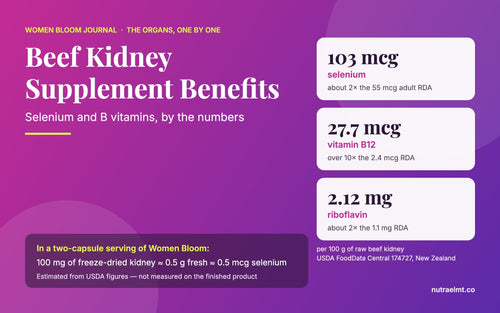
USDA FoodData Central keeps a separate entry for beef kidney labeled "New Zealand, imported," and it assays at 103 mcg of selenium per 100 g raw — about 27% lower than the 141 mcg in USDA's unspecified-origin kidney entry. Origin moves the number; it doesn't guarantee it moves up.

We reported the unspecified-origin figure ourselves in beef kidney supplement benefits, and neither number changes the arithmetic there: 100 mg of dried kidney is a small fraction of a 100 g raw sample either way. What the two entries show is narrower and more useful — origin is a real variable that a federal food database bothers to separate, which is more than "grass-fed" does on its own.
What about grass-fed beef liver specifically?
Liver is the organ most searched alongside "grass-fed," and a 2010 research review found that grass-based diets do shift beef's fatty acid and antioxidant profile — more conjugated linoleic acid and omega-3s, less of two less-favorable saturated fats. That review covered beef broadly, not freeze-dried organ powder, and we have not seen it repeated on liver alone.
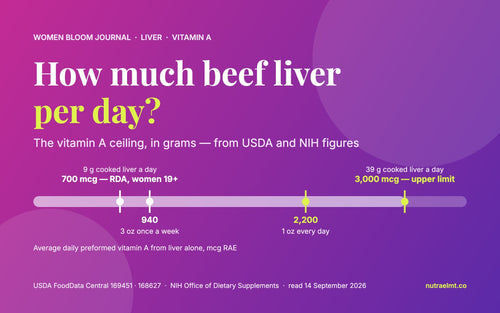
We keep our own liver claims narrower than that research for exactly this reason. Women Bloom's 150 mg of liver powder is discussed for what it is — a whole-food ingredient — in beef liver benefits for women, and the one number people search for most, vitamin A, is worked through separately in how much beef liver per day. We don't print a vitamin A figure for our own formula on this page or any other; the amount is too small to responsibly attach one.
What does this claim support, and what doesn't it?
It supports traceability: a named supplier, a batch number and a country for every organ, which most labels using "grass-fed" don't offer. It does not support a health claim or a purity pledge, and we never round it up to a full-percentage claim about origin anywhere on this site.
Nothing about where the cattle grazed changes what the finished capsule is allowed to say about your body. Any structure-function statement we make about zinc, biotin or the organs still carries the FDA disclaimer below and stops well short of treating, curing or preventing anything.* Sourcing and health claims are two different questions, and answering the first one honestly doesn't grant license on the second.
The short version
"Grass-fed" stopped carrying a federal verification in the U.S. when the USDA withdrew its voluntary standard in January 2016, so the word alone guarantees nothing. New Zealand's outdoor, pasture-based farming and export food-safety inspection are a different, verifiable layer, and Women Bloom documents all five organs against it — four supplier certificates of analysis and one specification, from three named suppliers. Origin does measurably shift nutrient numbers, as USDA's own kidney data shows, though not always upward, and we make no nutrient-content claim for the finished capsule beyond what is dosed and assayed on the label. What you can check for Women Bloom is the document, not the adjective.
Last reviewed: 25 September 2026. This article is general information, not medical advice.
*These statements have not been evaluated by the Food and Drug Administration. This product is not intended to diagnose, treat, cure, or prevent any disease.
Keep reading
*These statements have not been evaluated by the Food and Drug Administration. This product is not intended to diagnose, treat, cure, or prevent any disease. This article is for informational purposes only and is not medical advice. Speak with your healthcare provider before starting any supplement, especially if you are pregnant, nursing, taking medication, or managing a medical condition.