Vitamin B12 and Cellular Energy: What the Vitamin Actually Does

Vitamin B12 helps cells make red blood cells and DNA and run enzymes tied to energy metabolism, but it is not a fuel. A shortage can cause fatigue; extra B12 in someone who already has enough shows no performance benefit, according to the NIH.*
This page goes one level deeper than the B12 section of our iron, energy and women’s nutrition guide. That guide asks whether B12 gives you energy; this one asks what the vitamin does inside cells, who absorbs it poorly, and what a beef organ capsule can and cannot supply. Where the evidence ends, we say so, including about our own product.
The short version
Vitamin B12 is a cofactor, a helper for enzymes, not a source of calories. Low levels can cause fatigue and anemia, so the energy link is real in a shortage. Without one, the NIH finds no benefit from extra B12. A blood test, not a capsule, shows which case applies.*
What does vitamin B12 actually do in cells?
B12 works as a cofactor for two enzymes. Methionine synthase converts homocysteine to methionine; methylmalonyl-CoA mutase converts L-methylmalonyl-CoA to succinyl-CoA in propionate metabolism. The NIH adds that B12 supports red blood cell formation and DNA synthesis. A cofactor helps a reaction run; it does not add energy.*
The NIH describes B12 as having a role in energy metabolism, which is why it is so often promoted as an energy enhancer. The role is real, but it is a supporting one. Calories still come from carbohydrate, fat and protein, and a vitamin that helps enzymes handle the breakdown products does not supply any.
Why “cofactor” is not “fuel”
Think of a spark plug in an engine that already has petrol. Replacing a failed plug restores the engine; fitting a second plug to a healthy engine does not add power. That is the shape of the evidence on B12: a shortage matters, a surplus is simply not needed.
Does low B12 cause fatigue, and does extra B12 add energy?
Low B12 can cause fatigue, alongside anemia and neurological changes, so the link is real in a deficiency. In people with sufficient B12 status, the NIH says supplements appear to have no beneficial effect on performance. More B12 helps only when there was a shortage to correct.*
The NIH puts deficiency, defined as serum B12 under 200 pg/mL, at about 3.6% of US adults aged 19 and older, and insufficiency, under 300 pg/mL, at about 12.5%. Low or marginal status is much more common, up to 40% in Western populations. Those figures describe groups; they say nothing about your own level, and tiredness alone cannot tell you which group you are in.
Why a deficiency can take years to show
The body stores roughly 1 to 5 mg of B12, which the NIH puts at about 1,000 to 2,000 times a typical daily intake, so it notes that symptoms can take several years to appear. It also means a few weeks of a different diet rarely explains a sudden dip in energy. Sleep, iron, thyroid, stress and calories are far more common reasons, as our energy guide sets out.
Why do some people absorb too little vitamin B12?
Food B12 must be released from protein in the stomach, then bind a protein called intrinsic factor before it is absorbed in the ileum. Low stomach acid, pernicious anemia, gut disease or surgery, and some medicines can reduce that. In those cases the limit is absorption, not intake.

The NIH Office of Dietary Supplements B12 fact sheet reports that supplement absorption is about 50% at doses under 1 to 2 mcg, about 2% at 500 mcg and about 1.3% at 1,000 mcg. Higher doses therefore raise the amount absorbed only slightly. The NIH also notes that atrophic gastritis affects 8 to 9% of adults aged 65 and older, and that metformin, proton pump inhibitors and H2 blockers can lower B12 levels or absorption.
Who the NIH lists as at risk
Older adults, people with pernicious anemia or gastrointestinal disorders, people who have had gut surgery, and vegetarians and vegans, since natural food sources of B12 are limited to animal foods. If you are in one of those groups, the useful step is a conversation with a clinician, not a bigger number on a label.
Which foods supply the most vitamin B12?
Animal foods. The NIH lists 3 ounces of pan-fried beef liver at 70.7 mcg, cooked clams at 17 mcg and pan-browned 85% lean ground beef at 2.4 mcg. USDA data put raw beef liver at 59.3 mcg per 100 grams. The adult recommended intake is 2.4 mcg a day.

The USDA FoodData Central entry for raw beef liver gives the 59.3 mcg figure and shows liver at the top of the table. Kidney is lower but still dense in USDA data, at 27.7 mcg per 100 grams of raw New Zealand kidney, as we show in our beef kidney article.
Those are food numbers (how food forms compare with supplement forms is a separate question). A few ounces of liver on a plate and a few hundred milligrams of dried powder in a capsule are very different amounts, which is the next question.
Does Women Bloom supply vitamin B12?
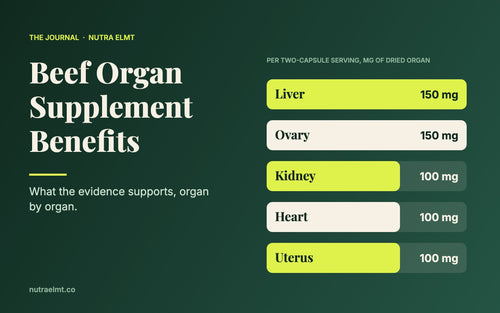
Not as a declared ingredient. The Supplement Facts panel lists biotin, zinc, collagen peptides and 600 mg of five beef organs, with no B12 line. Liver and kidney contain B12 as foods do, but the amount in our capsules has not been measured, so we make no B12 claim.
We can estimate, with limits. USDA lists raw liver at 70.8% water, so 150 mg of dried liver began as roughly 0.5 g of fresh tissue, which holds about 0.3 mcg of B12. The 100 mg of kidney adds about 0.14 mcg, by the arithmetic in our kidney article. Together that is about 0.4 mcg, under a fifth of the 2.4 mcg daily value, assuming drying loses nothing. These are food-table estimates, not lab results on the finished capsule.
That is why Women Bloom is described by what its panel actually declares, which you can read dose by dose on the Supplement Facts page, and not by a vitamin it does not list. Our guide to reading a supplement certificate of analysis explains why a printed number needs a measurement behind it. If B12 is your concern, food, or a product made and dosed for that purpose, is the honest route.
How do you find out whether your B12 is low?
Ask a clinician for a serum B12 test. The NIH notes that labs often treat values under 200 to 250 pg/mL as subnormal, and that a result between 150 and 399 pg/mL may call for a follow-up test of methylmalonic acid, or MMA. Tiredness by itself cannot tell you.
Bring the context a clinician needs: your diet, any digestive conditions, and medicines such as metformin or acid reducers. The NIH cautions that MMA and homocysteine can also rise for other reasons, including reduced kidney function, so a single number is read alongside the rest of the picture. Our energy guide lists what to ask a clinician to check, from iron stores to B12.
Last reviewed: 14 October 2026. This article is general information, not medical advice. Talk to your physician before starting any supplement.
*These statements have not been evaluated by the Food and Drug Administration. This product is not intended to diagnose, treat, cure, or prevent any disease.
Keep reading
*These statements have not been evaluated by the Food and Drug Administration. This product is not intended to diagnose, treat, cure, or prevent any disease. This article is for informational purposes only and is not medical advice. Speak with your healthcare provider before starting any supplement, especially if you are pregnant, nursing, taking medication, or managing a medical condition.