Freeze-Dried vs Heat-Processed Organ Supplements: What the Label Word Means

Freeze-dried organ supplements are frozen, then dried under vacuum; heat-processed ones are dried with warm air or cooked first. Both remove water. No trial we found compares the two in capsules, so the difference is a process claim, not a proven benefit.
This page sits beside our capsules versus powder article and our guide to choosing a beef organ supplement. Those pages compare forms and labels; this one asks what the word "freeze-dried" does and does not tell you. Where the evidence is thin, we say so, including about our own product.
The short version
Freeze-drying and heat-drying both turn fresh organs into a shelf-stable powder. Heat can lower some vitamins, such as thiamin, but no study we found measures that in organ capsules. Treat "freeze-dried" as a question to ask, and look for documents behind it.*
What is the difference between freeze-dried and heat-processed organs?
Freeze-drying freezes the tissue and then removes the ice as vapor under vacuum, so the organ never gets hot. Heat-processing dries or cooks it with warm air or higher temperatures. The result in both cases is a dry powder that can be encapsulated and stored without refrigeration.
That is the whole mechanical difference, and it is a real one. It is also only a description of a process. A label that says "freeze-dried" tells you how water was removed; it does not tell you the organ's source, the dose per capsule or whether anything was tested. Those questions are separate, and the capsules versus powder article covers the form side.
How much water does drying remove from an organ?
A lot. USDA data put raw beef liver at 70.8 grams of water per 100 grams. Drying removes most of that, so a dried powder is far more concentrated by weight than fresh tissue. That is why a few hundred milligrams of powder can stand in for a larger piece of fresh organ.

The USDA FoodData Central entry for raw beef liver lists 20.4 grams of protein beside the water. If nearly all the water is removed, 100 grams of fresh liver leaves roughly 29 grams of solids. That is arithmetic from a food table, not a measurement of any capsule.
Why the arithmetic matters for labels
It explains why milligrams of powder and grams of fresh organ cannot be compared directly. It also shows why moisture is worth asking about: a powder that keeps more water weighs more per capsule for the same amount of tissue.
Does heat reduce nutrients in organ powders?
For some vitamins, heat can lower the amount in food. The NIH says heating foods that contain thiamin can reduce their thiamin content. That is a general food fact. We found no study that measured it in dried organ powders, so no honest percentage exists for either method.
The NIH Office of Dietary Supplements thiamin fact sheet makes the statement about heating in its food section. Beef liver is, on the other hand, among the foods the NIH folate fact sheet lists with the highest folate levels, at 215 micrograms of dietary folate equivalents in a braised 3-ounce serving. Cooking clearly leaves plenty in the food; the fact sheets do not say how a drying step compares.
What we are not saying
We are not saying heat-dried powders are weak or that freeze-dried ones are strong. The sources above show that heat can matter for specific vitamins in food. They do not rank two drying methods for a capsule.
Is freeze-dried automatically better?
No. We found no head-to-head trial of freeze-dried and heat-dried organ capsules, and no human outcome data for either. Freeze-drying is a gentler process on paper, and a reasonable thing to prefer, but it is not proof of a better product. Source, dose and testing still matter.*
A gentler process is a plausible reason to choose one product over another, and a manufacturer is entitled to describe it. The mistake is treating the word as a result. A well-documented heat-dried powder with a certificate of analysis tells you more than an undocumented freeze-dried one.
What can our own documents show about freeze-drying?
Our product page states the organs are freeze-dried rather than heat-processed. Of the five supplier documents on our Lab Tests page, only the ovary specification mentions freeze-drying. We publish no moisture result for any organ or for the finished lot. So the claim is ours, and the paper trail is partial.

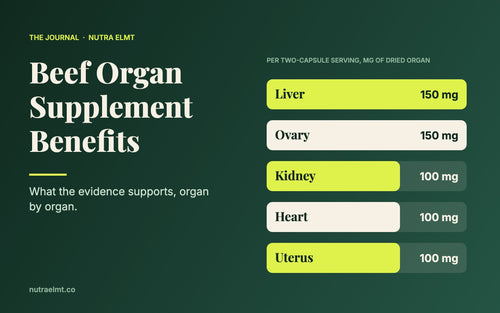
Our label lists five grass-fed organs with collagen, biotin and zinc, and the Supplement Facts page gives every dose: 600 mg of organs and 500 mg of collagen peptides per two capsules. The liver, heart, kidney and uterus documents record origin and amount, and say nothing about how the tissue was dried. We would rather state that gap than let a short phrase imply more. Our article on New Zealand grass-fed organs sets out what the origin papers do cover.
How can you check a process claim on a label?
Ask for the document behind the word. A certificate of analysis for the finished lot, a moisture result, a supplier specification that names the process, and a facility certification each prove something different. If none is published, the claim is the manufacturer's statement, and you can weigh it as such.
A short checklist helps. Is the process named for every organ or only some? Is there a moisture figure? Does the certificate cover the finished capsule or only the facility? Our guide to reading a supplement certificate of analysis goes line by line, and the choosing guide applies the same questions to every brand, ours included. The lab tests page shows what we publish and what we do not.
Last reviewed: 12 October 2026. This article is general information, not medical advice. Talk to your physician before starting any supplement.
*These statements have not been evaluated by the Food and Drug Administration. This product is not intended to diagnose, treat, cure, or prevent any disease.
Keep reading
*These statements have not been evaluated by the Food and Drug Administration. This product is not intended to diagnose, treat, cure, or prevent any disease. This article is for informational purposes only and is not medical advice. Speak with your healthcare provider before starting any supplement, especially if you are pregnant, nursing, taking medication, or managing a medical condition.