Beef Liver Supplements and Capsules: What One Capsule Actually Holds

A beef liver capsule holds dried liver powder: about 500 milligrams in a typical capsule, which began as roughly 1.7 grams of fresh liver. That is a small fraction of a food serving, so the amount on the label matters more than the word “liver”.*
This page says what that amount stands for in USDA terms, what to check on a liver supplement label, and where the evidence stops. It has no capsule trial to cite, because we know of none.
The short version
A beef liver capsule is dried liver powder, and the dose is small. A 500 mg capsule stands for about 1.7 g of fresh liver, and the 150 mg of liver in a two-capsule Women Bloom serving for about 0.5 g. No trial has tested liver capsules, so read the label for milligrams, origin and lot testing.*
What is a beef liver supplement, and what is in it?
It is beef liver with the water removed, ground to a powder and sealed in a capsule. Raw liver is 70.8 percent water in USDA data, so about 29 grams of solids remain from every 100 grams. The powder is the food minus its water, not an extract of a single vitamin.
Its nutrient profile therefore follows the USDA figures for raw beef liver: per 100 grams, 59.3 mcg of vitamin B12, 9.76 mg of copper, 2.76 mg of riboflavin, 290 mcg of folate and 4.9 mg of iron.
Desiccated, freeze-dried, heat-processed: what the words mean
They name the drying method, not the dose. We found no trial that compares them, and our piece on freeze-dried vs heat-processed organ supplements explains what each word tells you and what it leaves out.
How much fresh liver is in one beef liver capsule?
About 1.7 grams for a 500 mg capsule, and about 0.5 grams for the 150 mg of liver in a two-capsule serving of Women Bloom. The figure divides the powder weight by the 29.2 percent of solids in raw liver. A six-capsule, 3,000 mg all-liver serving works out to roughly 10 grams.

Against the 100-gram food serving, a capsule is a rounding error. Applying the same factor to our 150 mg gives about 0.3 mcg of vitamin B12, 13 percent of the 2.4 mcg Daily Value, and about 0.05 mg of copper, 6 percent of the 0.9 mg Daily Value. Riboflavin comes to about 1 percent, folate 0.4 percent and iron 0.1 percent.
What this arithmetic assumes
It assumes the USDA average sample (its four samples ran from 51.6 to 69.1 mcg of B12 per 100 grams), that drying removes only water, and that every nutrient survives. None of it was measured on our capsules: the panel does not declare B12, copper or riboflavin, so these are estimates, not label values.
Is an all-liver capsule different from a multi-organ capsule?
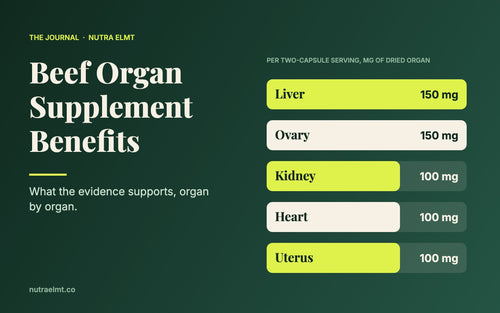
Yes, in what else is inside. An all-liver capsule gives liver’s profile alone, while a multi-organ formula divides its milligrams across several tissues. Women Bloom’s 600 mg of organs is 150 mg liver, 150 mg ovary, 100 mg kidney, 100 mg heart and 100 mg uterus, so liver is a quarter of the organ total.
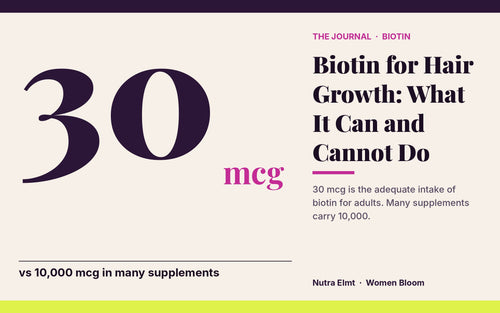
Women Bloom prints each amount on its Supplement Facts page, with 500 mg of collagen peptides, 10,000 mcg of biotin and 10 mg of zinc as zinc oxide beside them. Liver is the familiar organ, but it is one of five. How the whole category fits together is in our complete guide to beef organ supplements for women.
What should you check on a beef liver supplement label?
Check five things: the milligrams of liver, the other organs named, the origin, the drying word and a certificate for the lot. A label that prints “organ blend” without milligrams cannot be compared with anything, while one with numbers can be checked against its own certificate.

Our certificates are on the Lab Tests page. The lot results there are manufacturer-reported, and we describe them that way. Only the ovary specification there mentions freeze-drying, which is why the table says so.
What a missing number tells you
A label without milligrams is not wrong, but nothing on it can be checked. That is a limit of the label, not a verdict on the liver inside. A fair test: could a stranger compare this bottle with another one using only what is printed?
Is vitamin A a reason to be careful with liver capsules?
Liver is a concentrated source of preformed vitamin A, about 4,970 mcg RAE per 100 grams raw, against an NIH upper limit of 3,000 mcg a day. Capsule powder is a fraction of that, but it stacks with food and other supplements. Women Bloom’s panel declares no vitamin A, so we publish no figure.
The USDA entry shows almost all of that vitamin A as retinol, and the NIH Office of Dietary Supplements sets the limit for adults at 3,000 mcg a day, food and supplements combined. The grams-per-day arithmetic, with an estimate for a liver-only capsule, is in how much beef liver per day. If you are pregnant or planning to be, ask your physician before taking any liver product.
Is there evidence that beef liver capsules work?
Not directly. We know of no controlled trial of a beef liver capsule, and none of a multi-organ beef supplement in women. Liver’s nutrient values as a food are measured, but what a 150 mg or 500 mg dose does in a person has not been tested, so we claim only what the panel and certificate show.*
What exists is food data: the USDA measured the nutrients, and the NIH fact sheets describe what those nutrients do in the body. Until someone tests the capsule dose itself, a label with published milligrams and a lot certificate is the most a buyer can verify.
Last reviewed: 21 October 2026. This article is general information, not medical advice. Talk to your physician before starting any supplement, especially if you are pregnant or planning a pregnancy.
*These statements have not been evaluated by the Food and Drug Administration. This product is not intended to diagnose, treat, cure, or prevent any disease.
Keep reading
*These statements have not been evaluated by the Food and Drug Administration. This product is not intended to diagnose, treat, cure, or prevent any disease. This article is for informational purposes only and is not medical advice. Speak with your healthcare provider before starting any supplement, especially if you are pregnant, nursing, taking medication, or managing a medical condition.