Zinc, Skin and Women’s Nutrition: What the Evidence Shows

Zinc is an essential mineral involved in protein and DNA synthesis and wound healing, so a shortfall matters. For women who already get enough of it, we found no trial showing that extra zinc improves skin. The useful question is intake.
This page sits beside our look at the collagen, biotin and zinc trio and the wider guide to hair, skin and nails supplements. Those pages cover three ingredients together; this one takes zinc alone. Where evidence is missing, we say so.
The short version
Every tissue needs zinc, skin included, but the evidence is about shortfalls, not extras. The NIH says most people in the United States consume an adequate amount. We found no trial showing that extra zinc improves skin in people who already get enough, so intake is the question.
Does zinc do anything for skin?
Zinc takes part in protein and DNA synthesis, wound healing and cell signaling*, according to the NIH, and a deficiency affects many tissues. That is the solid part. We found no trial of extra zinc on healthy skin in people who already eat enough, so we promise nothing.
Where the evidence is solid
The evidence is about people who do not get enough zinc. The NIH Office of Dietary Supplements describes zinc as required for hundreds of enzymes and involved in immune function, protein and DNA synthesis and wound healing. It also notes that the body holds about 1.5 g of zinc in women, mostly in muscle and bone.
Where the evidence is silent
For a woman whose intake already meets the recommendation, we found no controlled trial showing that a higher dose does more for the skin. This page does not discuss skin conditions. If you have one, that is a conversation for your dermatologist.
How much zinc does a woman need each day?
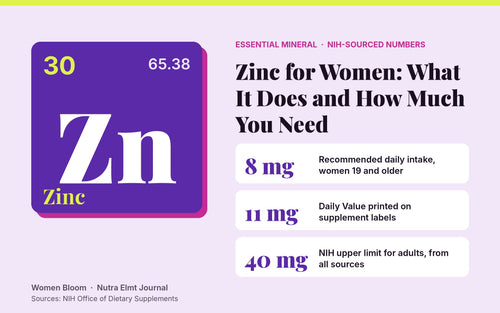
The recommended intake is 8 mg a day for women 19 and older, 11 mg during pregnancy and 12 mg while breastfeeding. The Daily Value printed on labels is 11 mg. The NIH upper limit for adults is 40 mg a day, and it is the ceiling to respect.

The Daily Value is one label number for everyone, so it will not match your own recommended intake exactly. The gap between 8 mg and 40 mg is wide, and the NIH notes that most people in the United States already consume an adequate amount.
Where does the zinc in a woman's diet come from?
Mostly from animal foods. The NIH names meat, fish and other seafood, eggs and dairy as good sources, with oysters particularly high. Beans, nuts and whole grains contain zinc too, but its bioavailability from those foods is lower than from animal foods, so plates are not equal.

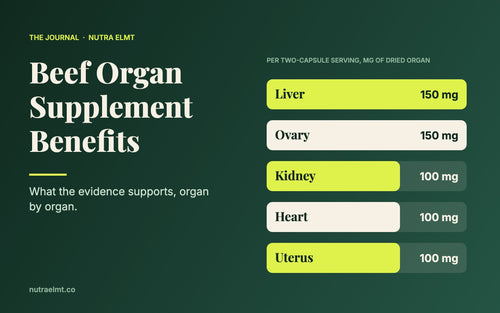
Organs are not a big zinc source in a capsule. USDA FoodData Central lists raw New Zealand beef kidney at 1.53 mg per 100 g, and raw beef heart at 1.51 mg per 100 g. Our arithmetic, not a measurement: if all five organs held what kidney and heart do, a 600 mg serving of dried organs would add well under 0.1 mg.
Can you get too much zinc?
Yes. The NIH upper limit is 40 mg a day for adults, and it says 50 mg or more over several weeks can inhibit copper absorption. Excess zinc can also cause nausea, dizziness, headaches and stomach upset. Add up the zinc from every product you take.
A high intake is more likely to come from supplements than from food. A multivitamin, an immune-support product and a beauty supplement can each carry zinc, and the amounts stack. That is why the label total matters more than any single bottle.
Who is more likely to fall short on zinc?
The NIH names people with gastrointestinal disorders or bariatric surgery, vegetarians and vegans, pregnant or lactating women, and people with alcohol use disorder. If you are in one of these groups, ask your physician or a registered dietitian about your intake rather than guessing or adding a supplement on your own.
The reasons differ by group: some people absorb less, some eat fewer animal foods, and pregnancy raises the target to 11 mg. A clinician who knows your history can tell you more than a bottle can. Our cycle nutrition article makes the same point about needs that stay constant through the month.
How much zinc is in Women Bloom?
Two capsules carry 10 mg of zinc, 91 percent of the 11 mg Daily Value and well under the 40 mg upper limit. It is added zinc, not zinc from the five organs, which contribute only a trace by our arithmetic. We do not claim it improves skin.
The serving is two capsules of Women Bloom, with 600 mg of freeze-dried organs, collagen peptides, biotin and zinc, all printed on the Supplement Facts page. Our certificate of analysis for lot 0125252 reports 13.83 mg of zinc measured against the 10 mg label, which is allowed by the 100 to 150 percent specification and still under the upper limit. We read that document line by line in how to read a supplement COA, and results are on our lab tests page. If you are pregnant, nursing or taking medication, talk to your physician first.
What should you check on a zinc label?
Check the milligrams per serving, the percent Daily Value and how many servings you take each day. Then add up zinc from every product, multivitamins included. A certificate of analysis that reports the measured amount lets you compare the label with the laboratory result.
Also check the form of zinc if the label names one. The NIH lists several forms used in supplements, and absorption can differ between them. Compare the label total with the reference values above, not with the front of the bottle.
Last reviewed: 5 October 2026. This article is general information, not medical advice. Talk to your physician before starting any supplement.
*These statements have not been evaluated by the Food and Drug Administration. This product is not intended to diagnose, treat, cure, or prevent any disease.
Keep reading
*These statements have not been evaluated by the Food and Drug Administration. This product is not intended to diagnose, treat, cure, or prevent any disease. This article is for informational purposes only and is not medical advice. Speak with your healthcare provider before starting any supplement, especially if you are pregnant, nursing, taking medication, or managing a medical condition.